Expiration date: 02/2028
Dosage form
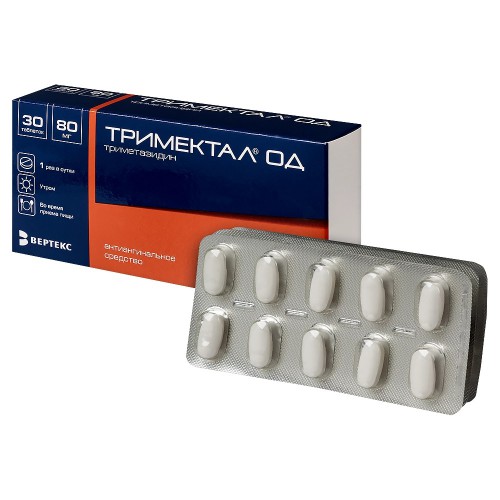
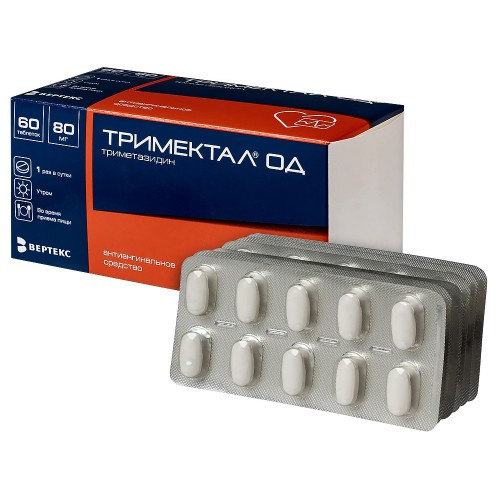
Oblong, biconvex, film-coated tablets ranging from white to yellowish-white in color. The core is white or off-white in cross-section.
Composition
One tablet contains:
active ingredient: trimetazidine dihydrochloride - 80.00 mg;
excipients: hypromellose, pregelatinized corn starch, magnesium stearate, colloidal silicon dioxide;
Film coating No. 1: [hypromellose, talc, titanium dioxide, macrogol 4000 (polyethylene glycol 4000)] or [dry film coating mixture containing hypromellose, talc, titanium dioxide, macrogol 4000 (polyethylene glycol 4000)];
Film coating No. 2: aqueous dispersion of ethyl cellulose for film coating, containing ethyl cellulose, 28% ammonia solution, medium-chain triglycerides, oleic acid in terms of dry matter.
Pharmacotherapeutic group
antianginal drug
Pharmacodynamics
Mechanism of action
Trimetazidine prevents the decrease in intracellular adenosine triphosphate (ATP) concentrations by maintaining cellular energy metabolism during hypoxia. Thus, trimetazidine ensures the normal functioning of membrane ion channels, the transmembrane transport of potassium and sodium ions, and the maintenance of cellular homeostasis.
Trimetazidine inhibits fatty acid oxidation by selectively inhibiting the mitochondrial long-chain fatty acid isoform 3-ketoacyl-CoA thiolase (3-KAT), which leads to increased glucose oxidation and accelerated glycolysis with glucose oxidation, thereby protecting the myocardium from ischemia. The shift in energy metabolism from fatty acid oxidation to glucose oxidation underlies the pharmacological properties of trimetazidine.
Pharmacodynamic properties:
- supports energy metabolism of the heart and neurosensory tissues during ischemia;
- reduces the severity of intracellular acidosis and changes in transmembrane ion flow that occur during ischemia;
- reduces the level of migration and infiltration of polynuclear neutrophils in ischemic and reperfused cardiac tissues;
- reduces the size of myocardial damage;
- does not have a direct effect on hemodynamic parameters.
In patients with angina, trimetazidine:
- increases coronary reserve, thereby slowing the onset of ischemia caused by physical activity, starting from the 15th day of therapy;
- limits exercise-induced blood pressure fluctuations without significant changes in heart rate;
- significantly reduces the frequency of angina attacks and the need for short-acting nitroglycerin;
- improves left ventricular contractile function in patients with ischemic dysfunction.
The results of clinical studies have confirmed the efficacy and safety of trimetazidine in patients with stable angina, both in monotherapy and as part of combination therapy when other antianginal drugs are ineffective.
In a study of 426 patients with stable angina, the addition of trimetazidine (60 mg/day) to metoprolol 100 mg/day (50 mg twice a day) for 12 weeks statistically significantly improved exercise test results and clinical symptoms compared with placebo: total exercise test duration, total exercise time, time to 1 mm ST-segment depression, time to angina attack, number of angina attacks per week, and short-acting nitrate consumption per week, without hemodynamic changes.
In a study of 223 patients with stable angina, the addition of trimetazidine 35 mg (twice daily) to atenolol 50 mg (once daily) for 8 weeks resulted in a 1-mm increase in the time to ischemic ST-segment depression during exercise testing in a subgroup of patients compared with placebo. A significant difference was also shown for the time to onset of angina attacks. No significant differences were found between groups for other secondary endpoints (total duration of exercise testing, total exercise time, and clinical endpoints).
In a study of 1962 patients with stable angina, trimetazidine at two doses (70 mg/day and 140 mg/day) was added to atenolol 50 mg/day compared with placebo. In the overall population, including both asymptomatic and symptomatic patients, trimetazidine demonstrated no benefits in terms of ergometric or clinical endpoints. However, in a post hoc analysis of the subgroup of symptomatic patients, trimetazidine (140 mg) significantly improved the total exercise test time and time to angina onset.
Pharmacokinetics
Suction
After oral administration, trimetazidine has a linear pharmacokinetic profile and reaches peak plasma concentrations approximately 14 hours after administration. Between doses (i.e., for 24 hours), trimetazidine plasma concentrations remain at least 75% of the peak concentration for 15 hours after administration.
Steady-state is achieved after the third dose (after 3 days). Food intake does not affect the bioavailability of trimetazidine.
Distribution
The volume of distribution is 4.8 l/kg, which indicates good distribution of trimetazidine in tissues (the degree of binding to plasma proteins is quite low, about 16% in vitro).
Withdrawal
Trimetazidine is excreted primarily by the kidneys, primarily unchanged. The half-life in young healthy volunteers is approximately 7 hours, and in patients over 65 years of age, approximately 12 hours.
Renal clearance of trimetazidine directly correlates with creatinine clearance (CC), hepatic clearance decreases with patient age.
Pharmacokinetics in special patient groups
Elderly patients
A dedicated clinical study conducted in an elderly population using a dose of trimetazidine MV 35 mg, 2 tablets daily (in 2 doses), showed an increase in plasma trimetazidine levels according to population pharmacokinetic analysis.
Elderly patients may have increased trimetazidine exposure due to age-related decline in renal function. A dedicated pharmacokinetic study in elderly (75-84 years) or very elderly (≥ 85 years) patients showed that moderate renal impairment
(CrCl 30-60 ml/min) increased trimetazidine exposure by 1.0 and 1.3 times, respectively, compared with younger patients (30-65 years) with moderate renal impairment.
Patients with impaired renal function
Trimetazidine exposure was increased on average by 1.7-fold in patients with moderate renal impairment (CrCl 30-60 mL/min) and on average by 3.1-fold in patients with severe renal impairment (CrCl <30 mL/min) compared to healthy volunteers with normal renal function.
No safety differences were observed in this patient population compared with the general population.
Patients of childhood and adolescence
The pharmacokinetics of trimetazidine in children and adolescents under 18 years of age has not been studied.
Indications
Long-term therapy of ischemic heart disease: prevention of attacks of stable angina as part of mono- or combination therapy.
Contraindications
- Hypersensitivity to the active substance or any of the excipients included in the drug.
- Parkinson's disease, parkinsonism symptoms, tremor, restless legs syndrome and other related movement disorders.
- Severe renal failure (creatinine clearance less than 30 ml/min).
- Due to the lack of sufficient clinical data, the drug is not recommended for use in patients under 18 years of age.
- Pregnancy and breastfeeding period.
With caution
- Patients with severe liver failure (10 to 15 points on the Child-Pugh scale).
- Patients with moderate renal impairment (creatinine clearance 30-60 ml/min).
- Patients over 75 years of age (see sections “Dosage and Administration” and “Special Instructions”).
Use during pregnancy and breastfeeding
Pregnancy
There are no data on the use of trimetazidine in pregnant women. Animal studies have not revealed any direct or indirect reproductive toxicity. The use of trimetazidine during pregnancy is contraindicated.
Breastfeeding period
There are no data on the excretion of trimetazidine or its metabolites in breast milk. A risk to the newborn/child cannot be excluded. If use of the drug during breastfeeding is necessary, breastfeeding should be discontinued.
Fertility
Reproductive toxicity studies revealed no effects of the drug on male or female rats.
Method of administration and dosage
Orally, 1 tablet once a day, in the morning, during breakfast.
The tablets should be taken whole, without chewing, with water.
The benefit of treatment can be assessed after three months of taking the drug.
The drug should be discontinued if there is no improvement within this time.
The duration of treatment is determined by the doctor.
Elderly patients
Patients over 75 years of age may have increased exposure to trimetazidine.
due to age-related decline in renal function (see section "Pharmacokinetics"). In patients with moderate renal impairment (CrCl 30-60 ml/min), a dose reduction is recommended, i.e., 1 tablet containing 35 mg trimetazidine per day.
Dose selection in patients over 75 years of age should be done with caution (see section “Special instructions”).
Patients with impaired renal function
In patients with moderate renal impairment (CC 30-60 ml/min) (See sections “Pharmacokinetics” and “Special instructions”), a dose reduction is recommended, i.e. 1 tablet containing 35 mg trimetazidine per day.
Patients with impaired liver function
Caution should be exercised when treating patients with severe hepatic impairment (see section "Special instructions") since the available data are limited and do not allow us to completely exclude the absence of an effect of liver dysfunction on the metabolism of trimetazidine.
Pediatric patients
The safety and efficacy of trimetazidine in patients under 18 years of age have not been established. No data are available.
Side effects
Classification of the frequency of development of side effects according to the recommendations of the World Health Organization (WHO):
very common ≥1/10;
common from ≥ 1/100 to < 1/10;
uncommon from ≥ 1/1000 to < 1/100;
rare from ≥ 1/10000 to < 1/1000;
very rare < 1/10000, including isolated reports;
frequency unknown - it is not possible to determine the frequency of occurrence based on the available data.
Blood and lymphatic system disorders:
frequency unknown - agranulocytosis, thrombocytopenia, thrombocytopenic purpura.
Nervous system disorders:
often - dizziness, headache;
Frequency unknown: Parkinsonism symptoms (tremor, akinesia, increased tone), unsteadiness of gait, restless legs syndrome, and other associated movement disorders, usually reversible after discontinuation of therapy. Sleep disturbances (insomnia, drowsiness).
Disorders of the auditory organ and labyrinth:
Frequency unknown - vertigo.
Cardiac disorders:
rarely - sensation of heartbeat, extrasystole, tachycardia.
Vascular disorders:
rarely - arterial hypotension, orthostatic hypotension, which may be accompanied by general weakness, dizziness or loss of balance, especially with the simultaneous use of antihypertensive drugs, "flushes" of blood to the skin of the face.
Gastrointestinal disorders:
often - abdominal pain, diarrhea, dyspepsia, nausea, vomiting;
frequency unknown - constipation.
Liver and biliary tract disorders:
frequency unknown - hepatitis.
Skin and subcutaneous tissue disorders:
often - skin rash, itching, urticaria;
frequency unknown - acute generalized exanthematous pustulosis, Quincke's edema.
General disorders and reactions at the injection site:
often - asthenia.
Overdose
There is very limited information on trimetazidine overdose. In case of overdose, symptomatic treatment should be administered.
Drug interactions
No interactions with other medications have been identified. Patients should inform their physician of all medications they are taking.
Special instructions
The drug is not intended for the relief of angina attacks and is not indicated for the initial course of therapy for unstable angina or myocardial infarction in the pre-hospital stage or in the first days of hospitalization.
If an attack of angina develops, the extent of coronary artery disease should be reassessed and, if necessary, treatment (drug therapy or possible revascularization procedure) should be adjusted. Trimetazidine may cause or worsen parkinsonian symptoms (tremor, akinesia, increased tone), so regular monitoring of patients, especially elderly patients, is necessary. In doubtful cases, patients should be referred to a neurologist for appropriate evaluation.
If movement disorders such as Parkinsonism symptoms, restless legs syndrome, tremors, or unsteadiness of gait occur, the drug should be permanently discontinued.
Such cases are rare, and symptoms usually resolve after discontinuing therapy: in most patients, within 4 months of stopping the drug. If Parkinsonism symptoms persist for more than 4 months after discontinuing the drug, a neurologist should be consulted.
Falls associated with gait instability or hypotension may occur, especially in patients taking antihypertensive medications (see "Side Effects"). Caution should be exercised when prescribing this drug to patients who may have increased exposure:
- in moderate renal failure (see sections “Pharmacological properties” and “Dosage and administration”).
- in elderly patients over 75 years of age (see section “Dosage and administration”).
Due to the dosage form of the drug "extended-release film-coated tablets", the gel-like framework of the tablet may not dissolve in the intestine and be excreted in the feces, which does not affect the therapeutic efficacy of the drug.
Impact on the ability to drive vehicles and operate machinery
During clinical studies, no effect of trimetazidine on hemodynamic parameters was observed; however, during the post-registration period, cases of dizziness and drowsiness were observed (see section “Side effects”), which may affect the ability to drive vehicles and operate machinery.
Storage temperature
from 2℃ to 25℃