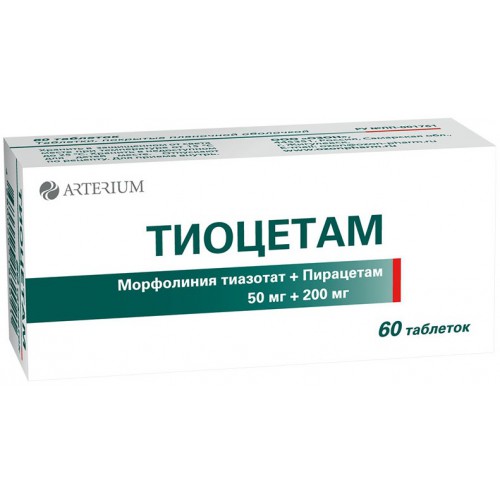
Expiration date: 10/2026
Compound
Composition per 1 tablet:
Active ingredients: piracetam in terms of 100% substance - 200.0 mg, thiotriazoline (morpholinium methyl triazolyl thioacetate) in terms of 100% substance - 50.0 mg, excipients: starch - potato - 23.47 mg, low molecular weight povidone (low molecular weight medical polyvinylpyrrolidone 126002700) - 3.5 mg, sucrose (powdered sugar) - 3.5 mg, microcrystalline cellulose - 66.03 mg, calcium stearate - 3.5 mg, film coating: Opadry II yellow (aluminum lake based on indigo carmine dye - 0.0012 mg, aluminum lake based on sunset yellow dye - 0.0045 mg, hypromellose - 2.4 mg, lactose monohydrate - 1.32 mg, macrogol - 0.48 mg, aluminum lake based on quinoline yellow dye - 0.21 mg, titanium dioxide - 1.22 mg, triacetin - 0.36 mg, iron oxide yellow dye - 0.0025 mg) - 356 mg.
Dosage form
Film-coated tablets.
Description
The tablets are round, biconvex, coated with a yellow film, and a white or almost white core is visible on the cross section.
Pharmacodynamics
Thiocetam belongs to the group of cerebroactive agents and exhibits nootropic/anti-ischemic and antioxidant properties.
The pharmacological effect of the drug is due to the mutually potentiating action of thiotriazoline and piracetam.
Piracetam is a cyclic GABA derivative, a nootropic agent that acts directly on the brain, improving functions such as learning, memory, attention, and consciousness without producing a sedative or psychostimulant effect.
At the neuronal level, piracetam facilitates various types of synaptic transmission, primarily affecting the density and activity of postsynaptic receptors. Piracetam's hemorrheological effects are related to its influence on red blood cells, platelets, and vascular walls.
Thiotriazoline reacts with reactive oxygen species and lipid radicals due to the pronounced reducing properties of the thiol group and prevents the formation of reactive oxygen species by reactivating antiradical enzymes: superoxide dismutase, catalase and glutathione peroxidase.
Thiocetam improves integrative and cognitive brain function, promotes the learning process, eliminates amnesia, and improves short-term and long-term memory.
Pharmacokinetics
Not studied.
Indications for use
Chronic cerebral ischemia, recovery period after ischemic stroke (including in patients with non-dementia cognitive impairment), diabetic encephalopathy.
Contraindications
Symptoms: occurrence or increase in the severity of dose-dependent side effects of the drug.
Treatment: drug discontinuation, induction of vomiting, gastric lavage, symptomatic therapy.
Use during pregnancy and breastfeeding
There is no experience with the use of the drug during pregnancy or breastfeeding, so the drug should not be prescribed to this category of women.
Side effects
From the nervous system: motor disinhibition, irritability, drowsiness, depression, asthenia, headache, dizziness, tinnitus, insomnia, mental agitation, imbalance, ataxia, exacerbation of epilepsy, anxiety, hallucinations, confusion,
From the gastrointestinal tract: nausea, vomiting, diarrhea, abdominal pain (including gastralgia) and bloating, dry mouth,
From the cardiovascular system: tachycardia, increased blood pressure, pain in the heart, arrhythmia, in the elderly, exacerbation of coronary insufficiency is possible,
Allergic reactions: hypersensitivity, anaphylactic reactions including dermatitis, itching, urticaria and angioedema, fever,
From the respiratory system: shortness of breath, attacks of suffocation,
From the side of metabolism: increase in body weight,
From the auditory organs: vertigo.
Interaction
Thiocetam should not be administered concomitantly with medications that have an acidic pH. The presence of piracetam enhances the effects of antidepressants and antianginal medications. Confusion, irritability, and sleep disturbances are possible when administered concomitantly with thyroid hormones.
Piracetam does not inhibit cytochrome P450 isoenzymes. Metabolic interactions with other drugs are unlikely.
Concomitant administration with alcohol did not affect the serum concentration of piracetam; serum ethanol concentration did not change when taking 1.6 g of piracetam.
Method of administration and dosage
Orally, 30 minutes before meals.
For chronic cerebrovascular accidents and during the recovery period after ischemic stroke, take 2 tablets 3 times daily for 25-30 days. The course of treatment can be extended to 3-4 months.
For the treatment of diabetic encephalopathy, 2 tablets are prescribed 3 times a day for 45 days.
The last dose should be taken no later than 5 p.m. (to prevent sleep disturbances).
Overdose
Symptoms: occurrence or increase in the severity of dose-dependent side effects of the drug.
Treatment: drug discontinuation, induction of vomiting, gastric lavage, symptomatic therapy.
Special instructions
During long-term therapy in elderly patients, regular monitoring of renal function is recommended; if necessary, the dose is adjusted depending on creatinine clearance.
Impact on the ability to drive vehicles and operate machinery
During the treatment period, it is necessary to refrain from driving vehicles and engaging in potentially dangerous activities that require increased concentration and quick psychomotor reactions (driving a car, etc.).
Release form
Film-coated tablets.
Conditions of dispensing from pharmacies
By prescription
Storage conditions
Store in a place protected from light at a temperature of 15 to 25 C.
Keep out of reach of children.
Best before date
2 years. Do not use after the expiration date stated on the package.