Expiration date: 01/2029
Method of administration and dosage
Orally, 30 minutes before meals. Adults: 200-400 mg (1-2 tablets) 3 times daily. Daily dose: 1200 mg.
Children over 7 years old: 200 mg (1 tablet) 1-3 times a day.
Daily dose 600 mg.
The course of treatment is 2-3 weeks.
If you miss a dose, take the medication as soon as possible or, if it is almost time for your next dose, skip the missed dose. Do not take a double dose at once.
If improvement does not occur after treatment, or if symptoms worsen, or if new symptoms appear, consult a doctor. Use the medication only as directed, as directed, and in the dosages specified in the instructions.
Indications
Hyperkinetic dyskinesia of the biliary tract and sphincter of Oddi, noncalculous chronic cholecystitis, cholangitis, cholelithiasis; post-surgical conditions on the gallbladder and biliary tract. Decreased appetite, nausea, constipation, vomiting (due to bile hyposecretion).
Compound
Active ingredient: hymecromone - 200 mg:
Excipients: corn starch - 45.00 mg, gelatin - 3.00 mg, sodium lauryl sulfate - 1.00 mg, magnesium stearate - 1.00 mg.
Contraindications
Hypersensitivity to the active substance or any other component included in the composition, biliary obstruction, renal/hepatic insufficiency, ulcerative colitis and Crohn's disease, gastric ulcer and duodenal ulcer, hemophilia, children under 7 years of age.
Use during pregnancy and breastfeeding
There is no data on the safety of using hymecromone during pregnancy and breastfeeding.
Prescribing Odecromone to pregnant women and during breastfeeding is permissible only in cases where the potential benefit to the mother outweighs the potential risk to the fetus and child.
Special instructions
Does not impair the secretory function of the digestive glands and intestinal absorption processes.
If symptoms of liver and/or kidney failure occur, stop taking the drug and consult a doctor.
Impact on the ability to drive vehicles and operate machinery
The drug does not affect the ability to drive vehicles or engage in potentially hazardous activities that require increased concentration and speed of psychomotor reactions.
Packaging and release form
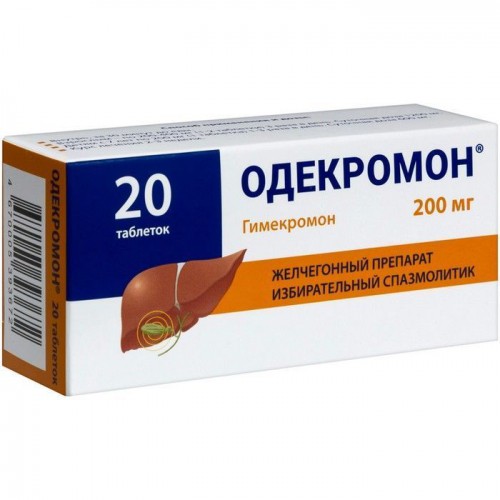
Tablets of 200 mg - 20 pcs per pack.
Side effects
Allergic reactions, diarrhea, flatulence, abdominal pain, ulceration of the gastrointestinal mucosa, headache are possible.
If you experience any side effects listed in the instructions or if they worsen, or if you notice any other side effects not listed in the instructions, tell your doctor.
Pharmacotherapeutic group
choleretic agent
Interaction with other drugs
Morphine weakens the effects of gnomecromone. When taken concomitantly with metoclopramide, the effects of both drugs are reduced. It enhances the effects of indirect anticoagulants. If you are taking any of the above medications or other medications (including over-the-counter medications), consult your doctor before using odecromone.
Pharmacodynamics
A choleretic agent. Hymecromone is a coumarin derivative. It increases bile production and secretion and accelerates its flow through the biliary tract. It has a selective antispasmodic effect on the bile ducts and sphincter of Oddi (without reducing gastrointestinal motility or blood pressure). It reduces bile stasis, preventing cholesterol crystallization and thereby gallstone formation.
Storage temperature
from 2℃ to 25℃
Dosage form
angular, flat-cylindrical tablets from almost white to white in colour with bevelled edges on both sides and a score line on one side.
Pharmacokinetics
When administered orally, it is readily absorbed from the gastrointestinal tract and weakly binds to plasma proteins. Peak serum concentrations are reached within 2-3 hours. The half-life is approximately 1 hour. Hymecromone is excreted by the kidneys (approximately 93% as glucuronate, 1.4% as sulfonate, and 0.3% as unchanged drug).
Overdose
To date, no cases of overdose have been registered.