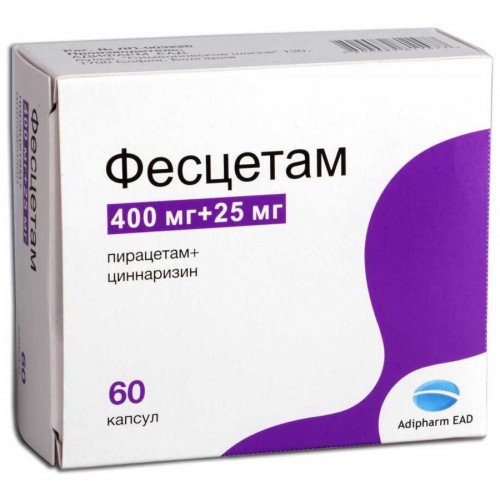
Expiration date: 05/2028
Compound
Each capsule contains:
active ingredients: piracetam 400 mg and cinnarizine 25 mg,
Excipients: starlak (lactose monohydrate 85%, corn starch 15%) 43 mg, colloidal silicon dioxide anhydrous 3 mg, magnesium stearate 5 mg, capsule body - gelatin, titanium dioxide, capsule cap - gelatin, titanium dioxide (E171).
Dosage form
capsules
Description
Hard, cylindrical gelatin capsules, size No. 0, white (white/white).
Capsule contents: a powdery mixture from white to almost white in colour, the presence of conglomerates is allowed, which turn into powder when pressed with a glass rod.
Pharmacodynamics
Fescetam is a combination medication with pronounced antihypoxic, nootropic, and vasodilatory effects. The active components mutually potentiate the reduction in cerebral vascular resistance and promote increased blood flow.
Piracetam is a nootropic agent. It activates metabolic processes in the brain by enhancing energy and protein metabolism, accelerating cellular glucose utilization, and increasing their resistance to hypoxia. It improves interneuronal transmission in the central nervous system (CNS) and regional blood flow in the ischemic zone.
Cinnarizine is a selective calcium channel blocker. It has been shown to inhibit calcium ion influx into cells and reduce their levels in plasma membrane depots. It reduces arteriolar smooth muscle tone, diminishing their response to biogenic vasoconstrictors (epinephrine, norepinephrine, dopamine, angiotensin, and vasopressin). It has a vasodilatory effect (especially in the cerebral vessels, enhancing the antihypoxic effect of piracetam) without significantly affecting blood pressure. It exhibits moderate antihistamine activity, reduces vestibular excitability, and lowers sympathetic tone. It increases the elasticity of red blood cell membranes and their deformability, and reduces blood viscosity.
Pharmacokinetics
Suction
After oral administration, piracetam and cinnarizine are rapidly and almost completely absorbed from the gastrointestinal tract (GIT).
C max (maximum concentration in blood plasma) of piracetam in blood plasma is achieved within 2-6 hours. The bioavailability of piracetam is 100%.
Cinnarizine is absorbed slowly. Maximum plasma concentrations of cinnarizine are reached within 1–4 hours. Cinnarizine's bioavailability increases in an acidic environment.
Distribution
Piracetam does not bind to plasma proteins. The apparent volume of distribution (Vd ) is approximately 0.6 L/kg. Piracetam readily penetrates the blood-brain barrier and placental barrier, penetrates all organs and tissues, and also passes through filter membranes used in hemodialysis. Piracetam reaches its peak concentration in the cerebrospinal fluid (CSF) within 2-8 hours. It accumulates selectively in the cerebral cortex, primarily in the frontal, parietal, and occipital lobes, the cerebellum, and the basal ganglia.
Cinnarizine binds to plasma proteins at a rate of 9%. Within 1-4 hours of oral administration, it is found in the liver, kidneys, heart, lungs, spleen, and brain.
Metabolism
Piracetam is practically not metabolized.
Cinnarizine is extensively and completely metabolized in the liver via dealkylation by the CYP2D6 isoenzyme. This metabolism begins within 30 minutes of oral administration.
Withdrawal
The half -life of piracetam in plasma is 4-5 hours, and in cerebrospinal fluid, 8.5 hours. 80-100% of piracetam is excreted unchanged by the kidneys via renal filtration. Renal clearance of piracetam in healthy volunteers is 86 ml/min.
T 1/2 of cinnarizine is 4 hours. 1/3 of the metabolites are excreted by the kidneys, 2/3 through the intestines.
Pharmacokinetics in special clinical situations
The half-life of piracetam is prolonged in renal insufficiency. Piracetam's pharmacokinetics are not altered in patients with hepatic insufficiency.
Indications for use
- Insufficiency of cerebral circulation (atherosclerosis of cerebral vessels, recovery period of ischemic and hemorrhagic strokes, after traumatic brain injury, encephalopathy of various origins),
- psychoorganic syndrome with a predominance of symptoms of asthenia and adynamia,
- asthenic syndrome,
- labyrinthopathy (dizziness, tinnitus, nystagmus, nausea, vomiting),
- Meniere's syndrome,
- prevention of kinetosis.
Contraindications
- Hypersensitivity to the components of the drug,
- galactose intolerance, lactase deficiency and glucose-galactose malabsorption,
- severe liver failure (more than 9 points on the Child-Pugh scale),
- severe renal impairment (creatinine clearance (CC) less than 20 ml/min),
- psychomotor agitation at the time of drug administration,
- Huntington's chorea,
- hemorrhagic stroke,
- pregnancy,
- the period of breastfeeding,
- children under 5 years of age.
Use during pregnancy and breastfeeding
Fescetam is contraindicated for use during pregnancy and breastfeeding.
There are no adequate and well-controlled studies on the safety of piracetam during pregnancy. Use is only permitted when the expected benefit to the mother outweighs the potential risk to the fetus. Piracetam is excreted in breast milk. Experimental studies have not revealed any adverse effects of piracetam on the fetus.
During pregnancy and breastfeeding, the use of cinnarizine is possible only in exceptional cases when the expected benefit to the mother significantly outweighs the potential risk to the fetus or infant.
Side effects
Side effects are distributed by frequency of occurrence as follows: very often (10%), often (1% and <10%), infrequently (0.1% and <1%), rarely (0.01% and <0.1%), very rarely, including individual messages (<0.01%).
From the digestive system: rarely - increased salivation, nausea, vomiting, diarrhea, abdominal pain.
From the central nervous system and psyche: hyperkinesia, nervousness, increased sexual activity, drowsiness, depression, in some cases - dizziness, headaches, ataxia, imbalance, insomnia, confusion, agitation, anxiety, hallucinations,
Allergic reactions: very rare - skin rash, dermatitis, itching, swelling, photosensitivity.
With long-term therapy in elderly patients, tremor may occur.
Interaction
When used simultaneously with Fescetam, it is possible that the sedative effect of drugs that depress central nervous system activity, tricyclic antidepressants, and ethanol may be enhanced.
Fescetam potentiates the action of nootropic and hypotensive drugs.
When used simultaneously, vasodilators enhance the effect of the drug.
Fescetam improves the tolerability of antipsychotic drugs and tricyclic antidepressants.
The effect of oral anticoagulants may be enhanced.
Method of administration and dosage
Orally, regardless of meal time.
Adults: The average daily dose is 1-2 capsules 3 times a day for 1-3 months, depending on the severity of the disease.
For children over 5 years old: the average daily dose is 1-2 capsules 1-2 times a day (no more than 3 months).
Patients with mild to moderate renal impairment (CC less than 60 ml/min) should reduce the therapeutic dose or increase the interval between doses of the drug.
Overdose
Information on overdose is limited.
Symptoms : Overdose does not cause serious side effects requiring discontinuation of treatment. Gastrointestinal disturbances may occur in case of overdose.
In children, the most common symptoms are excitability: insomnia, anxiety, irritability, euphoria, tremors, and in rare cases, nightmares and hallucinations.
Treatment: induce vomiting, perform gastric lavage. Treatment is symptomatic. Hemodialysis may be used. There is no specific antidote.
Special instructions
Use with caution in patients with liver and/or kidney disease.
In case of mild to moderate renal failure (CC less than 60 ml/min), the therapeutic dose should be reduced or the interval between doses of the drug should be increased.
In patients with impaired liver function, liver enzyme activity should be monitored.
You should avoid drinking alcohol while taking Fescetam.
This medicinal product should not be taken by patients with galactose intolerance, lactase deficiency or glucose-galactose malabsorption syndrome.
Impact on the ability to drive vehicles and operate machinery
During the treatment period, it is necessary to refrain from potentially dangerous activities that require increased attention and high speed of psychomotor reactions.
Release form
Capsules, 400 mg + 25 mg.
Package
10 or 15 capsules in a PVC/Al blister.
6 or 4 blisters together with instructions for medical use in a cardboard pack.
Conditions of dispensing from pharmacies
By prescription
Storage conditions
At a temperature not exceeding 25 C.
Keep out of reach of children.
Best before date
3 yearsDo not use after the expiry date stated on the package.
Manufacturer and organization accepting consumer complaints
ADIFARM EAD