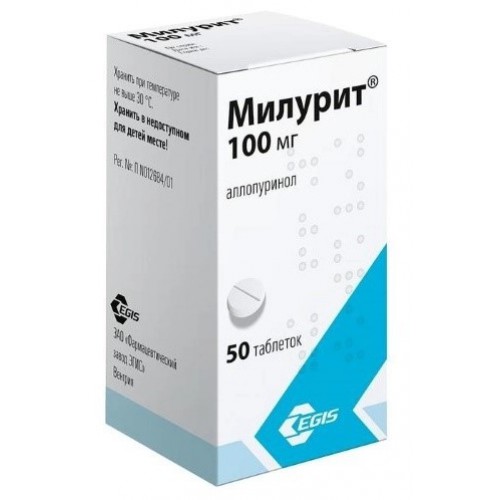
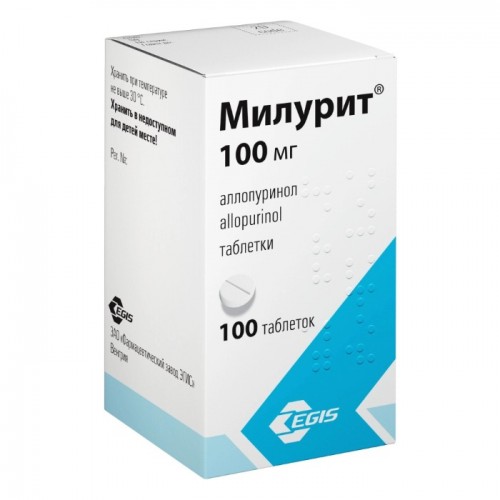
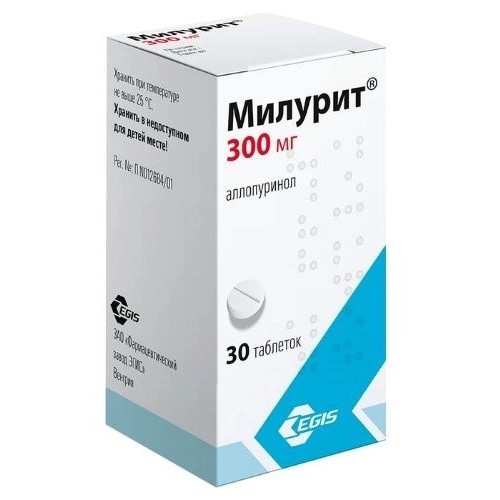
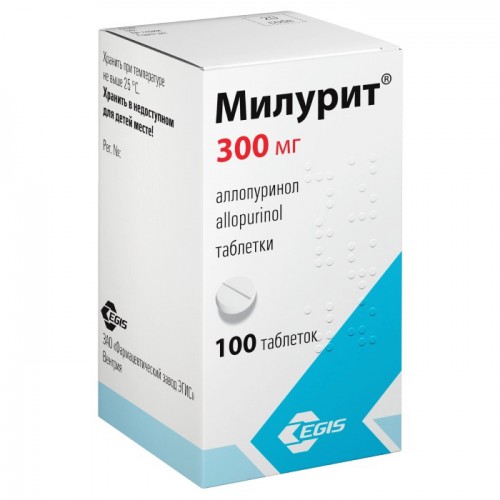
Expiration date: 01/2031
Pharmacological action
A drug that disrupts uric acid synthesis. It is a structural analogue of hypoxanthine. It inhibits the enzyme xanthine oxidase, which is involved in the conversion of hypoxanthine to xanthine and xanthine to uric acid. This results in a decrease in the concentration of uric acid and its salts in body fluids and urine, which promotes the dissolution of existing urate deposits and prevents their formation in tissues and kidneys. Taking allopurinol increases the excretion of hypoxanthine and xanthine in the urine.
Pharmacokinetics
After oral administration, it is almost completely (90%) absorbed from the gastrointestinal tract. It is metabolized to form alloxanthin, which retains its ability to inhibit xanthine oxidase for a relatively long time. The peak plasma concentration of allopurinol is reached on average within 1.5 hours, and that of alloxanthin is reached within 4.5 hours after a single dose.
The half-life of allopurinol is 1-2 hours, alloxanthin is about 15 hours. About 20% of the dose taken is excreted through the intestines, the rest is excreted by the kidneys.
Indications of the drug
Treatment and prevention of gout and hyperuricemia of various origins (including those associated with nephrolithiasis, renal failure, and urate nephropathy). Recurrent mixed calcium oxalate kidney stones in the presence of hyperuricosuria. Increased urate formation due to enzymatic disorders. Prevention of acute nephropathy during cytostatic and radiation therapy for tumors and leukemia, as well as during complete therapeutic fasting.
Dosage regimen
The dosage is determined individually, based on monitoring of urate and uric acid levels in the blood and urine. Adults take 100-900 mg/day orally, depending on the severity of the disease. The dosage is 2-4 times a day after meals. Children under 15 years of age take 10-20 mg/kg/day or 100-400 mg/day.
Maximum dose: for renal impairment (including those caused by urate nephropathy) - 100 mg/day. A dose increase may be necessary if elevated urate levels in the blood and urine persist despite ongoing therapy.
Side effects
From the cardiovascular system: in isolated cases - arterial hypertension, bradycardia.
From the digestive system: dyspeptic phenomena (including nausea, vomiting), diarrhea, transient increase in the activity of transaminases in the blood serum are possible; rarely - hepatitis; in isolated cases - stomatitis, liver dysfunction (transient increase in the activity of transaminases and alkaline phosphatase), steatorrhea.
From the central nervous system and peripheral nervous system: in isolated cases - weakness, increased fatigue, headache, dizziness, ataxia, drowsiness, depression, coma, paresis, paresthesia, convulsions, neuropathy, visual impairment, cataracts, changes in the optic nerve papilla, taste disturbances.
From the hematopoietic system: in some cases - thrombocytopenia, agranulocytosis and aplastic anemia, leukopenia (most likely in patients with impaired renal function).
From the urinary system: rarely - interstitial nephritis; in isolated cases - edema, uremia, hematuria.
From the endocrine system: in isolated cases - infertility, impotence, gynecomastia, diabetes mellitus.
From the side of metabolism: in isolated cases - hyperlipidemia.
Allergic reactions: skin rash, hyperemia, itching; in isolated cases - angioimmunoblastic lymphadenopathy, arthralgia, fever, eosinophilia, fever, Stevens-Johnson syndrome, Lyell's syndrome.
Dermatological reactions: in isolated cases - furunculosis, alopecia, hair bleaching.
Contraindications
Severe liver and/or kidney dysfunction, pregnancy, lactation, hypersensitivity to allopurinol.
Use during pregnancy and breastfeeding
Contraindicated for use during pregnancy and lactation (breastfeeding).
Use in liver dysfunction
Contraindication: severe liver dysfunction.
Allopurinol should be used with caution in patients with impaired function
liver (dose reduction is necessary).
Use in renal impairment
Contraindication: severe renal impairment.
Allopurinol should be used with caution in patients with impaired renal function.
(dose reduction is necessary).
Use in children
In children, it is used only for malignant neoplasms (especially leukemia), as well as for certain enzyme disorders (Lesch-Nyhan syndrome).
The dosage regimen is established individually, under the control of the concentration of urates and uric acid in the blood and urine: for children under 15 years of age - 10-20 mg/kg/day or 100-400 mg/day.
Special instructions
Allopurinol should be used with caution in patients with impaired liver and/or kidney function (in both cases, a dose reduction is necessary) and hypothyroidism. Regular liver function tests are necessary during the initial period of allopurinol therapy.
During treatment with allopurinol, the daily amount of fluid consumed should be at least 2 liters (under the control of diuresis).
An exacerbation of gout may occur early in treatment. NSAIDs or colchicine (0.5 mg 3 times daily) can be used for prevention. It should be noted that adequate allopurinol therapy may dissolve large urate stones in the renal pelvis and subsequently pass into the ureter.
Asymptomatic hyperuricemia is not an indication for the use of allopurinol.
In children, it is used only for malignant neoplasms (especially leukemia), as well as for certain enzyme disorders (Lesch-Nyhan syndrome).
To correct hyperuricemia in patients with cancer, allopurinol is recommended before initiating cytostatic therapy. In such cases, the minimum effective dose should be used. Furthermore, to reduce the risk of xanthine deposition in the urinary tract, measures should be taken to maintain optimal diuresis and alkalinize the urine. When allopurinol and cytostatic agents are used concomitantly, more frequent monitoring of peripheral blood counts is necessary.
While taking allopurinol, alcohol consumption is not allowed.
Impact on the ability to drive vehicles and operate machinery
Use with caution in patients whose activities require high concentration and rapid psychomotor reactions.
Drug interactions
When used simultaneously, allopurinol enhances the effect of coumarin anticoagulants, adenine arabinoside, and hypoglycemic drugs (especially in cases of impaired renal function).
Uricosuric agents and salicylates in high doses reduce the activity of allopurinol.
When allopurinol and cytostatics are used simultaneously, myelotoxic effects are more common than when used separately.
When allopurinol and azathioprine or mercaptopurine are used simultaneously, accumulation of the latter in the body is observed, since due to the inhibition of xanthine oxidase activity by allopurinol, which is necessary for the biotransformation of drugs, their metabolism and elimination are slowed down.