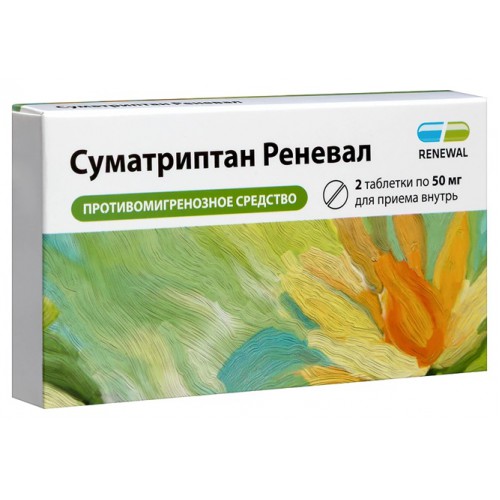



Expiration date: 02/2028
Dosage form
Round, biconvex, film-coated tablets, white or off-white. The core is white or off-white when viewed cross-sectionally.
Compound
Composition per tablet
Active ingredient: sumatriptan succinate - 140.0 mg (in terms of sumatriptan - 100.0 mg);
Excipients: lactose monohydrate, microcrystalline cellulose, sodium croscarmellose, povidone K30, magnesium stearate; shell composition: hypromellose, titanium dioxide, macrogol-4000
Pharmacotherapeutic group
anti-migraine drug
Pharmacodynamics
Mechanism of action
Sumatriptan is a selective 5-hydroxytryptamine-1 receptor (5-HT1D) agonist that does not affect other 5-HT receptor subtypes (5-HT2, 5-HT7). 5-HT1D receptors are located primarily in the cranial blood vessels of the brain, and their stimulation leads to vasoconstriction.
In animals, sumatriptan selectively acts by vasoconstricting branches of the carotid artery without affecting blood flow in the cerebral vessels. The carotid artery vascular bed supplies extracranial and intracranial tissues (including the meninges), and dilation of these vessels and/or swelling of their walls is believed to be the primary mechanism for migraine in humans.
Furthermore, experimental data suggest that sumatriptan reduces trigeminal nerve sensitivity. Both of these effects may underlie sumatriptan's antimigraine action.
The clinical effect is usually observed 30 minutes after oral administration of 100 mg of the drug.
Although the recommended oral dose is 50 mg, migraine attacks vary in severity both within and between patients. Doses of 25 mg to 100 mg have shown greater efficacy than placebo in clinical trials, but 25 mg is statistically significantly less effective than 50 mg and 100 mg.
Sumatriptan has demonstrated efficacy in the treatment of migraine attacks, including menstrual-associated migraine, which is migraine without aura that occurs between three days before and five days after the onset of menstruation.
Pharmacokinetics
Migraine attacks do not significantly affect the pharmacokinetics of orally administered sumatriptan.
Suction
After oral administration, sumatriptan is rapidly absorbed, with 70% of the maximum plasma concentration reached within 45 minutes. Following a 100 mg dose, the mean maximum plasma concentration is 54 ng/mL. The mean absolute bioavailability is 14%, partly due to first-pass metabolism and partly due to incomplete absorption.
Distribution
Sumatriptan binds to plasma proteins to a small extent (14-21%), the average total volume of distribution is 170 L.
Metabolism
It is metabolized by oxidation via monoamine oxidase (MAO) to form metabolites, the main one being the indole-2-oxo-2-serotonin analogue sumatriptan, which lacks pharmacological activity at 5-HT1 and 5-HT2 serotonin receptors. No minor metabolites of sumatriptan have been identified.
Withdrawal
The elimination half-life is approximately 2 hours. The major metabolite (the indolexine analogue of sumatriptan) is excreted renally as the free acid and glucuronide. The mean total plasma clearance is approximately 1160 mL/min, the mean renal clearance is approximately 260 mL/min, and extrarenal clearance accounts for approximately 80% of the total clearance.
Pharmacokinetics in special patient groups
Patients with impaired liver function
Due to a decrease in presystemic clearance of sumatriptan in patients with impaired liver function, the level of sumatriptan in blood plasma increases.
Patients of different age groups
Pharmacokinetics in patients over 65 years of age does not differ significantly from that in younger patients.
Indications
Relief of migraine attacks with or without aura, including menstrual-associated migraine attacks. Prescribed only with a verified diagnosis of migraine.
Contraindications
- Hypersensitivity to any of the components included in the drug;
- hemiplegic, basilar and ophthalmoplegic forms of migraine;
- ischemic heart disease (IHD), including suspicion of it, angina pectoris (including Prinzmetal's angina), myocardial infarction (including history), post-infarction cardiosclerosis, as well as symptoms that suggest the presence of IHD;
- occlusive diseases of peripheral vessels;
- stroke or transient ischemic attack (including history);
- uncontrolled arterial hypertension;
- concomitant administration with ergotamine or its derivatives (including methysergide) or other triptans/5-HT1 receptor agonists;
- use while taking monoamine oxidase inhibitors (MAO) or earlier than 2 weeks after discontinuing these drugs;
- concomitant administration with other 5-HT1-serotonin receptor agonists;
- severe impairment of liver and/or kidney function;
- lactase deficiency, galactose intolerance and glucose-galactose malabsorption syndrome (the drug contains lactose);
- age under 18 years and over 65 years (safety and efficacy have not been established).
With caution
- Controlled arterial hypertension;
- diseases that may alter the absorption, metabolism or excretion of this drug (eg, impaired renal or hepatic function);
- epilepsy (including any conditions with a decrease in the seizure threshold);
- in patients with hypersensitivity to sulfonamides (sumatriptan may cause allergic reactions, the severity of which varies from cutaneous manifestations of hypersensitivity to anaphylaxis). Data on cross-sensitivity are limited, but caution should be exercised when using sumatriptan in such patients.
- pregnancy;
- breastfeeding period.
Use during pregnancy and breastfeeding
Pregnancy
Caution should be exercised when using the drug during pregnancy; the potential benefit to the mother and possible risks to the fetus must be assessed.
Postmarketing data from over 1,000 women taking sumatriptan during the first trimester of pregnancy are available. Due to insufficient data and the increased risk of congenital malformations, it is premature to draw definitive conclusions.
Experience with the drug in women during the second and third trimesters of pregnancy is limited. Animal studies have shown no direct teratogenic or adverse effects on prenatal or postnatal development. However, effects on embryonic and fetal viability were observed in rabbits.
Breastfeeding period
Sumatriptan has been shown to be excreted into breast milk after subcutaneous administration. To avoid adverse effects on the infant, breastfeeding should be discontinued for 24 hours after discontinuing administration.
Method of administration and dosage
The drug Sumatriptan Renewal should not be used for prophylactic purposes.
The drug should be used at the first sign of a migraine attack. Sumatriptan is equally effective at any stage of a migraine attack.
The drug is taken orally by swallowing the tablet whole with water.
The recommended dose is 50 mg. Some patients may require a higher dose of 100 mg.
If a migraine attack is not relieved after the first dose, a second dose should not be taken for the same migraine attack. In such cases, paracetamol, aspirin, or nonsteroidal anti-inflammatory drugs can be used to relieve the attack. However, sumatriptan can be used to relieve subsequent migraine attacks.
If the patient experienced improvement after the first dose and then symptoms returned, a second dose can be taken within the next 24 hours. However, the maximum sumatriptan dose should not exceed 300 mg in any 24-hour period.
Sumatriptan should not be administered earlier than 24 hours after taking medications containing ergotamine; conversely, medications containing ergotamine should not be administered earlier than 6 hours after taking sumatriptan.
Special patient groups
Children and adolescents (under 18 years of age)
The efficacy of sumatriptan in this patient group has not been demonstrated.
Elderly patients
Experience with sumatriptan in patients over 65 years of age is limited. Pharmacokinetics in this population do not differ significantly from those in younger patients, but until additional clinical data are available, use in patients over 65 years of age is not recommended.
Patients with renal failure
In patients with renal insufficiency, doses should be lower (25-50 mg).
Side effects
The adverse reactions presented below are listed according to the organ system affected and frequency of occurrence. Frequency is defined as follows: “very common” (> 1/10); “common” (? 1/100, < 1/10); “uncommon” (? 1/1,000, < 1/100); “rare” (? 1/10,000, < 1/1,000); “very rare” (< 1/10,000), “frequency unknown” - cannot be estimated from the available data.
Clinical trial data
Nervous system disorders: common - dizziness, drowsiness, sensory disturbances including paresthesia and decreased sensitivity.
Vascular disorders: common - transient increase in blood pressure (shortly after taking the drug), hot flashes.
Respiratory, thoracic and mediastinal disorders: common - dyspnea.
Gastrointestinal disorders: often - nausea, vomiting (a causal relationship between the occurrence of adverse reactions and taking the drug has not been proven).
Musculoskeletal and connective tissue disorders: common - feeling of heaviness (usually transient, can be intense and occur in any part of the body, including the chest and throat), myalgia.
General disorders: common - pain, feeling of cold or heat, feeling of pressure or tightness (usually transient, can be intense and occur in any part of the body, including the chest and throat), weakness, fatigue (usually mild or moderate, transient).
Laboratory and instrumental data: very rarely - minor deviations in liver function tests.
Post-registration surveillance data
Immune system disorders: Frequency unknown - hypersensitivity reactions that range from cutaneous hypersensitivity reactions to anaphylaxis.
Nervous system disorders: common - seizures (in some cases in patients with a history of seizures or concomitant conditions predisposing to seizures; in some patients, no risk factors were identified), tremor, dystonia, nystagmus, scotoma.
Visual disturbances: frequency unknown - flickering, diplopia, decreased visual acuity. Vision loss (usually transient). However, visual disturbances may be caused by the migraine attack itself.
Cardiac disorders: frequency unknown - bradycardia, tachycardia, palpitations, arrhythmia, ECG signs of transient myocardial ischemia, coronary vasospasm, angina pectoris, myocardial infarction.
Vascular disorders: frequency unknown - decreased blood pressure, Raynaud's syndrome.
Gastrointestinal disorders: frequency unknown - ischemic colitis, diarrhea.
Musculoskeletal and connective tissue disorders: frequency not known - neck stiffness, arthralgia.
Psychiatric disorders: frequency unknown - anxiety.
Skin and subcutaneous tissue disorders: frequency unknown - hyperhidrosis.
Some of the symptoms that have been described as adverse events may be symptoms associated with migraine.
It is important to report any adverse reactions to ensure continued monitoring of the benefit-risk balance of the medication. If any of the side effects listed in the instructions worsen, or you notice any other side effects not listed in the instructions, please notify your doctor. Healthcare professionals should report any adverse reactions to the medication through national adverse reaction reporting systems.
Overdose
Symptoms
Oral administration of sumatriptan at doses greater than 400 mg did not cause any adverse reactions other than those listed above.
Animal overdose simulations resulted in seizures, tremors, paralysis, immobility, ptosis, redness of the extremities, abnormal respiration, cyanosis, ataxia, mydriasis, salivation and lacrimation, and death.
Treatment
In case of overdose, patients should be monitored for at least 12 hours and symptomatic treatment should be administered if necessary. There are no data on the effect of hemodialysis or peritoneal dialysis on plasma sumatriptan concentrations.
Drug interactions
No interactions were observed between sumatriptan and propranolol, flunarizine, pizotifen and ethyl alcohol.
When taken simultaneously with ergotamine, prolonged vascular spasm was observed.
There are limited data on interactions with drugs containing ergotamine or other triptans/5-HT1 receptor agonists. A theoretically increased risk of coronary vasospasm is possible, and concomitant use of these drugs is contraindicated.
The period of time that must elapse between doses of sumatriptan
and ergotamine-containing medications or another triptan/5-HT1 receptor agonist is unknown. It will depend, among other things, on the dose and type of medication prescribed. The effect may be additive. It is recommended to wait at least 24 hours after taking medications containing ergotamine or another triptan/5-HT1 receptor agonist before using sumatriptan. Conversely, it is recommended to wait at least
at least 6 hours after taking sumatriptan before taking ergotamine-containing products, and at least 24 hours before taking another type of triptan/5-HT1 receptor agonist.
There may be an interaction between sumatriptan and an MAO inhibitor; their concomitant use is contraindicated.
There have been rare postmarketing reports of serotonin syndrome (including mental disorders, autonomic instability, and neuromuscular disturbances) following the concomitant use of selective serotonin reuptake inhibitors (SSRIs) and sumatriptan. Serotonin syndrome has also been reported with the concomitant use of triptans with selective serotonin and norepinephrine reuptake inhibitors (SNRIs).
Adverse reactions may occur more frequently during the concomitant use of triptans and herbal preparations containing St. John's wort.
Special instructions
Sumatriptan should only be prescribed if the diagnosis of migraine is clear.
Sumatriptan should not be used for prophylactic purposes.
Sumatriptan is contraindicated for hemiplegic, basilar, and ophthalmoplegic migraines. As with other medications used to treat acute migraine attacks, other neurological conditions must be excluded before treating a headache attack in patients with previously undiagnosed migraine or in patients with atypical migraines. It should be noted that patients with migraine are at increased risk of developing certain cerebrovascular disorders (e.g., stroke or transient ischemic attacks).
Taking sumatriptan may be associated with transient symptoms such as chest pain and tightness radiating to the neck; these symptoms may be intense. If there is reason to believe these symptoms are a manifestation of coronary heart disease, appropriate diagnostic testing is necessary.
Sumatriptan should not be used in patients at risk for cardiovascular disease without prior evaluation to exclude it (such patients include postmenopausal women, men over 40 years of age, and patients with risk factors for coronary heart disease). However, evaluation does not always detect heart disease in every patient. In very rare cases, patients without a history of cardiovascular disease may experience serious adverse cardiovascular reactions.
Sumatriptan should be used with caution in patients with controlled hypertension, as transient increases in blood pressure and peripheral vascular resistance have been observed in a small number of patients.
There have been rare postmarketing reports of serotonin syndrome (including mental disorders, autonomic instability, and neuromuscular disturbances) following the concomitant use of SSRIs and sumatriptan. Serotonin syndrome has also been reported with the concomitant use of triptans and SSRIs.
If a patient is prescribed concomitant use of SSRIs and/or SNRIs, the patient's condition should be carefully monitored.
Concomitant use of any triptan (5-HT1 agonist) with sumatriptan is not recommended.
Sumatriptan should be used with caution in patients in whom the absorption, metabolism or excretion of sumatriptan may be significantly altered, such as patients with renal or hepatic impairment (Child-Pugh class A or B).
Sumatriptan should be used with caution in patients with a history of seizures or other risk factors for lowering the seizure threshold.
In patients with known hypersensitivity to sulfonamides, sumatriptan may cause allergic reactions, ranging from cutaneous hypersensitivity reactions to anaphylaxis. Data on cross-sensitivity are limited, but caution should be exercised when using sumatriptan in these patients.
Adverse reactions may occur more frequently during the concomitant use of triptans and herbal preparations containing St. John's wort (Hypericum perforatum).
Migraine medication overuse is associated with increased headache severity in susceptible patients (medication-overuse headache). In this case, discontinuing the medication should be considered.
The recommended dose of sumatriptan should not be exceeded.
Patients with rare hereditary problems of lactose intolerance, the Lapp lactase deficiency or glucose-galactose malabsorption should not take Sumatriptan Renewal because it contains lactose.
Impact on the ability to drive vehicles and operate machinery
Migraine patients may experience drowsiness, both related to the migraine itself and to sumatriptan. Patients should exercise particular caution when driving or operating machinery.
Storage temperature
from 2℃ to 25℃