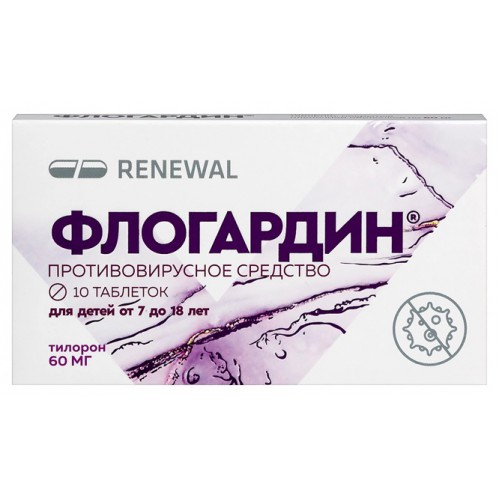
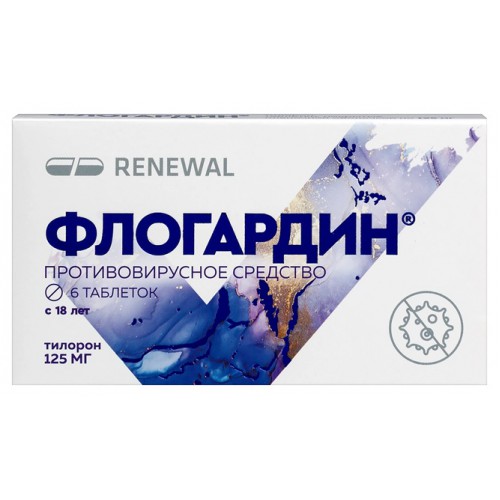
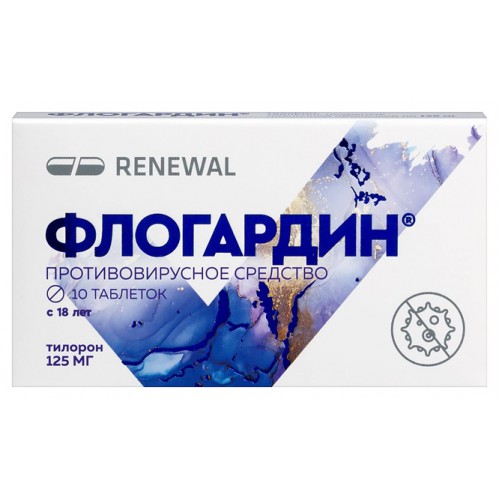
Expiration date: 10/2027
Compound
For one tablet:
Active ingredient :
Tilorone dihydrochloride
125,0000 mg
Excipients :
microcrystalline cellulose 101
120,0000 mg
potato starch
46,0000 mg
povidone K 30
3.0000 mg
calcium stearate
3.0000 mg
croscarmellose (croscarmellose sodium)
3.0000 mg
Shell composition:
VIVACOAT® PC-3P-386[hypromellose
6.8100 mg
titanium dioxide
3.5630 mg
macrogol 4000
0.9130 mg
Sunset Yellow dye (E 110)
0.3530 mg
quinoline yellow dye (E 104)
0.2470 mg
polysorbate 80 (tween 80)]
0.1140 mg
Dosage form
film-coated tablets
Description
Round, biconvex, orange film-coated tablets. When viewed cross-sectionally, the core is orange, with minor darker or lighter inclusions permitted.
Pharmacodynamics
A low-molecular-weight synthetic interferon inducer that stimulates the production of all types of interferons (alpha, beta, gamma, and lambda) in the body. The main interferon producers in response to tilorone are intestinal epithelial cells, hepatocytes, T-lymphocytes, neutrophils, and granulocytes. After oral administration, maximum interferon production is observed in the intestine-liver-blood sequence within 4-24 hours. Tilorone has immunomodulatory and antiviral effects. According to experimental studies, after a single oral administration of tilorone at a dose equivalent to the maximum daily dose for humans, the maximum concentration of interferon lambda in lung tissue is observed after 24 hours, and interferon alpha after 48 hours. Induction of interferon lambda in lung tissue helps enhance antiviral protection of the respiratory tract during influenza and other respiratory viral infections. Tilorone induces interferon synthesis in human leukocytes. It stimulates bone marrow stem cells, increases antibody production, reduces immunosuppression, and restores the T-suppressor/T-helper cell ratio, depending on the dose. It is effective against various viral infections, including influenza viruses, other acute respiratory viral infections, hepatitis viruses, and herpes viruses. Its antiviral action is associated with the inhibition of the translation of virus-specific proteins in infected cells, thereby suppressing viral reproduction.
Pharmacokinetics
After oral administration, tilorone is rapidly absorbed from the gastrointestinal tract. Bioavailability is 60%. Approximately 80% of tilorone is bound to plasma proteins. Tilorone is eliminated virtually unchanged through the feces (70%) and the kidneys (9%). The half-life (T1/2) is 48 hours. Tilorone does not undergo biotransformation and does not accumulate in the body.
Indications for use
As part of complex therapy in adults: treatment of influenza and other acute respiratory viral infections; treatment of herpes infection. Prevention of influenza and other acute respiratory viral infections in adults.
Contraindications
Hypersensitivity to tilorone or other components of the drug; pregnancy and breastfeeding; children under 18 years of age.
Use during pregnancy and breastfeeding
The use of Flogardin® during pregnancy is contraindicated. If the drug must be prescribed during lactation, breastfeeding should be discontinued.
Side effects
Allergic reactions, dyspepsia, and short-term chills are possible. If any of the side effects listed in the instructions worsen, or you notice any other side effects not listed in the instructions, notify your doctor.
Interaction
Compatible with antibiotics and medications for viral and bacterial infections. No clinically significant interactions between tilorone and antibiotics or conventional treatments for viral and bacterial infections have been identified. If you are taking any of the above-mentioned medications or other medications (including over-the-counter medications), consult your doctor before using Flogardin®.
Method of administration and dosage
Orally, after meals. For adults: For the treatment of influenza and other acute respiratory viral infections - 125 mg per day for the first 2 days of treatment, then 125 mg after 48 hours. The course dose is 750 mg (6 tablets). For the prevention of influenza and other acute respiratory viral infections - 125 mg once a week for 6 weeks. The course dose is 750 mg (6 tablets). For the treatment of herpes infection - 125 mg for the first two days, then 125 mg after 48 hours. The course dose is 1.25-2.5 g (10-20 tablets). When treating influenza and other acute respiratory viral infections, if symptoms persist for more than 4 days, consult a doctor. Use the drug only as directed, as directed, and in the doses specified in the instructions.
Overdose
There are no known cases of overdose with Flogardin®.
Special instructions
The product contains sunset yellow dye (E 110), which may cause allergic reactions.
Impact on the ability to drive vehicles and operate machinery
The drug Flogardin® does not have a negative effect on the ability to drive vehicles and engage in other potentially dangerous activities that require increased concentration and speed of psychomotor reactions.
Release form
Film-coated tablets, 125 mg.
Conditions of dispensing from pharmacies
Over the counter
Storage conditions
In a package at a temperature not exceeding 25°C. Keep out of reach of children.
Best before date
3 years. Do not use after expiration date.
Manufacturer and organization accepting consumer complaints
UPDATE OF PFC, JSC Russia