Expiration date: 11/2027
Compound
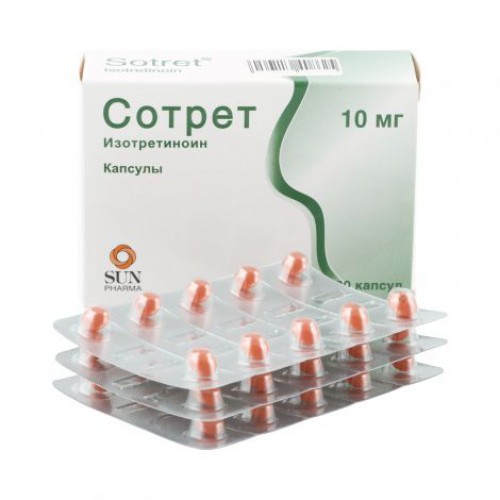
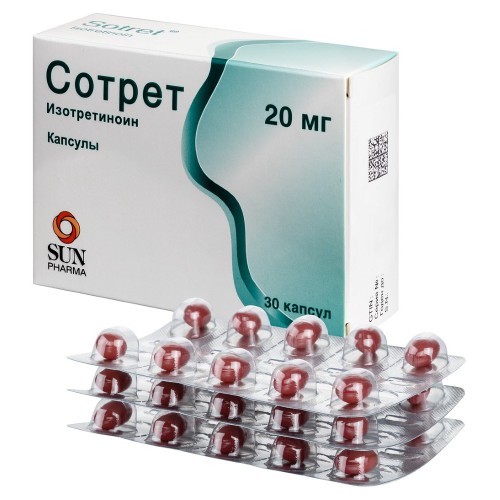
Each capsule contains 10mg or 20 mg isotretinoin.
Pharmacokinetics
Retinoid for systemic treatment of acne
Isotretinoin is a stereoisomer of all-trans-retinoic acid (tretinoin). The exact mechanism of action of Sotret has not yet been elucidated, but improvement in the clinical picture of severe acne is associated with suppression of sebaceous gland activity and histologically confirmed reduction in their size. Furthermore, isotretinoin's anti-inflammatory effect on the skin has been proven.
Hyperkeratosis of the hair follicle and sebaceous gland epithelial cells leads to the shedding of corneocytes into the gland duct, leading to its blockage with keratin and excess sebum. This leads to comedone formation and, in some cases, inflammation. Sotret inhibits sebocyte proliferation and acts on acne by restoring normal cell differentiation. Sebum is the primary growth substrate for Propionibacterium acnes, so reducing sebum production inhibits bacterial colonization of the duct.
Indications for use
Severe acne (nodulocystic acne, acne conglobata, or acne with the risk of scarring).
Acne that does not respond to other treatments.
Contraindications
Pregnancy is an absolute contraindication for Sotret therapy. If pregnancy occurs despite precautions during treatment or within one month after completion of therapy, there is a very high risk of the child being born with severe birth defects.
Isotretinoin is a drug with a strong teratogenic effect. If pregnancy occurs while a woman is taking isotretinoin orally (at any dose, even for a short period), there is a very high risk of the baby being born with birth defects.
Isotretinoin is contraindicated in women of childbearing age unless the woman's condition meets all of the following criteria:
she must have severe acne that is resistant to conventional treatment,
she must be sure to understand and follow the doctor's instructions,
she must be informed by the doctor of the risk of pregnancy during treatment with Sotret, for one month after treatment and urgently consult if pregnancy is suspected,
she must be warned of the possible failure of contraception,
she must confirm that she understands the precautions,
she must understand the need for and continuously use effective contraception for one month before treatment with Sotret, during treatment and for one month after its completion (see Interaction with other medicinal products), it is advisable to use 2 different methods of contraception at the same time, including a barrier method,
she must have obtained a negative result of a reliable pregnancy test within 11 days before starting treatment with the drug, a pregnancy test is strongly recommended to be performed monthly during treatment and 5 weeks after the end of therapy,
she should start treatment with Sotret only on the 2nd or 3rd day of the next normal menstrual cycle,
she must understand the need for mandatory visits to the doctor every month,
when treating for a relapse of the disease, she should to consistently use the same effective contraceptive methods for one month before starting treatment with Sotret, during treatment, and for one month after its completion, and to undergo the same reliable pregnancy test,
she must fully understand the need for precautions and confirm her understanding and willingness to use reliable contraceptive methods explained to her by her
doctor.
The use of contraceptives as directed above during treatment with isotretinoin should be recommended even to women who do not normally use contraceptive methods due to infertility (except for patients who have undergone hysterectomy), amenorrhea, or who report being sexually inactive.
The physician must be satisfied that:
the patient has severe acne (nodulocystic, conglobate, or acne at risk of scarring), acne that is refractory to other treatments,
a negative, reliable pregnancy test has been obtained before starting treatment, during treatment, and 5 weeks after the end of treatment, the dates and results of pregnancy tests must be documented,
the patient uses at least 1, preferably 2, effective methods of contraception, including a barrier method, for one month before starting treatment with Sotret, during treatment, and for one month after its end,
the patient is able to understand and comply with all of the above requirements for contraception,
the patient meets all of the above conditions.
Pregnancy test
In accordance with current practice, a pregnancy test with a minimum sensitivity of 25 tIU/ml should be performed in the first 3 days of the menstrual cycle:
Before starting therapy:
To exclude possible pregnancy before initiating contraception, the result and date of the initial pregnancy test should be recorded by the physician. For patients with irregular menstrual periods, the timing of the pregnancy test depends on sexual activity and should be performed 3 weeks after unprotected intercourse. The physician should inform the patient about contraceptive methods.
The pregnancy test should be performed on the day of Sotret administration or 3 days before the patient's appointment. The physician should record the test results. This medication can only be prescribed to patients who have been using effective contraception for at least 1 month prior to starting Sotret therapy.
During therapy:
The patient should see a doctor every 28 days. The need for monthly pregnancy testing is determined according to local practice and taking into account sexual activity and previous menstrual irregularities. If indicated, a pregnancy test should be performed on the day of the visit or three days before, and the results should be recorded.
End of therapy:
5 weeks after the end of therapy, a test is performed to exclude pregnancy.
A prescription for Sotret for a woman of childbearing potential can only be written for 30 days of treatment; continued therapy requires a new prescription from a doctor. It is recommended that a pregnancy test, prescription, and medication be filled on the same day.
Sotret should only be dispensed at the pharmacy within 7 days of the prescription being filled.
Full information about the teratogenic risk and strict adherence to contraceptive measures should be provided to both men and women.
Use during pregnancy and breastfeeding
Pregnancy is an absolute contraindication for Sotret therapy. If pregnancy occurs despite precautions during treatment or within one month after completion of therapy, there is a very high risk of the child being born with severe birth defects.
Isotretinoin is a drug with a strong teratogenic effect. If pregnancy occurs while a woman is taking isotretinoin orally (at any dose, even for a short period), there is a very high risk of the baby being born with birth defects.
Isotretinoin is contraindicated in women of childbearing age unless the woman's condition meets all of the following criteria:
she must have severe acne that is resistant to conventional treatment,
she must be sure to understand and follow the doctor's instructions,
she must be informed by the doctor of the risk of pregnancy during treatment with Sotret, for one month after treatment and urgently consult if pregnancy is suspected,
she must be warned of the possible failure of contraception,
she must confirm that she understands the precautions,
she must understand the need for and continuously use effective contraception for one month before treatment with Sotret, during treatment and for one month after its completion (see Interaction with other medicinal products), it is advisable to use 2 different methods of contraception at the same time, including a barrier method,
she must have obtained a negative result of a reliable pregnancy test within 11 days before starting treatment with the drug, a pregnancy test is strongly recommended to be performed monthly during treatment and 5 weeks after the end of therapy,
she should start treatment with Sotret only on the 2nd or 3rd day of the next normal menstrual cycle,
she must understand the need for mandatory visits to the doctor every month,
when treating for a relapse of the disease, she should to consistently use the same effective contraceptive methods for one month before starting treatment with Sotret, during treatment, and for one month after its completion, and to undergo the same reliable pregnancy test,
she must fully understand the need for precautions and confirm her understanding and willingness to use reliable contraceptive methods explained to her by her
doctor.
The use of contraceptives as directed above during treatment with isotretinoin should be recommended even to women who do not normally use contraceptive methods due to infertility (except for patients who have undergone hysterectomy), amenorrhea, or who report being sexually inactive.
The physician must be satisfied that:
the patient has severe acne (nodulocystic, conglobate, or acne at risk of scarring), acne that is refractory to other treatments,
a negative, reliable pregnancy test has been obtained before starting treatment, during treatment, and 5 weeks after the end of treatment, the dates and results of pregnancy tests must be documented,
the patient uses at least 1, preferably 2, effective methods of contraception, including a barrier method, for one month before starting treatment with Sotret, during treatment, and for one month after its end,
the patient is able to understand and comply with all of the above requirements for contraception,
the patient meets all of the above conditions.
Pregnancy test
In accordance with current practice, a pregnancy test with a minimum sensitivity of 25 tIU/ml should be performed in the first 3 days of the menstrual cycle:
Before starting therapy:
To exclude possible pregnancy before initiating contraception, the result and date of the initial pregnancy test should be recorded by the physician. For patients with irregular menstrual periods, the timing of the pregnancy test depends on sexual activity and should be performed 3 weeks after unprotected intercourse. The physician should inform the patient about contraceptive methods.
The pregnancy test should be performed on the day of Sotret administration or 3 days before the patient's appointment. The physician should record the test results. This medication can only be prescribed to patients who have been using effective contraception for at least 1 month prior to starting Sotret therapy.
During therapy:
The patient should see a doctor every 28 days. The need for monthly pregnancy testing is determined according to local practice and taking into account sexual activity and previous menstrual irregularities. If indicated, a pregnancy test should be performed on the day of the visit or three days before, and the results should be recorded.
End of therapy:
5 weeks after the end of therapy, a test is performed to exclude pregnancy.
A prescription for Sotret for a woman of childbearing potential can only be written for 30 days of treatment; continued therapy requires a new prescription from a doctor. It is recommended that a pregnancy test, prescription, and medication be filled on the same day.
Sotret should only be dispensed at the pharmacy within 7 days of the prescription being filled.
Full information about the teratogenic risk and strict adherence to contraceptive measures should be provided to both men and women.
Side effects
Most Sotret side effects are dose-dependent. Generally, when prescribed at the recommended dose, the benefit-to-risk ratio, taking into account the severity of the disease, is acceptable to the patient. Side effects are usually reversible with dose adjustment or discontinuation of the drug, but some may persist after treatment is stopped.
Symptoms associated with hypervitaminosis A: dry skin, mucous membranes, including lips (cheilitis), nasal cavity (bleeding), laryngopharynx (hoarseness), eyes (conjunctivitis, reversible corneal opacity and contact lens intolerance).
Skin and its appendages, rash, itching, facial erythema/dermatitis, sweating, pyogenic granuloma, paronychia, onychodystrophy, increased proliferation of granulation tissue, persistent hair thinning, reversible hair loss, fulminant forms of acne, hirsutism, hyperpigmentation, photosensitivity, photoallergy, easy skin trauma. At the beginning of treatment, acne may worsen, persisting for several weeks.
Musculoskeletal system: muscle pain with or without increased serum CPK levels, joint pain, hyperostosis, arthritis, calcification of ligaments and tendons, other bone changes, tendinitis.
Central nervous system and mental sphere: behavioral disturbance, depression, headache, increased intracranial pressure (pseudobrain tumor: headache, nausea, vomiting, visual impairment, papilledema), seizures.
Sensory organs: isolated cases of visual acuity impairment, photophobia, impaired dark adaptation (decreased twilight vision), rarely - color perception disorder (resolving after drug discontinuation), lenticular cataract, keratitis, blepharitis, conjunctivitis, eye irritation, papilledema (as a manifestation of intracranial hypertension), hearing impairment at certain sound frequencies.
Gastrointestinal tract: nausea, diarrhea, inflammatory bowel disease (colitis, ileitis), bleeding, pancreatitis (especially with concomitant hypertriglyceridemia above 800 mg/dL). Rare cases of fatal pancreatitis have been reported. Transient and reversible increases in liver transaminase activity, isolated cases of hepatitis. In many of these cases, the changes remained within normal limits and returned to baseline values during treatment; however, in some situations, it was necessary to reduce the dose or discontinue Sotret.
Respiratory system: rare - bronchospasm (more common in patients with a history of bronchial asthma).
Blood system: anemia, decreased hematocrit, leukopenia, neutropenia, increased or decreased platelet count, increased ESR.
Laboratory findings: hypertriglyceridemia, hypercholesterolemia, hyperuricemia, decreased high-density lipoprotein levels, and, rarely, hyperglycemia. Cases of new-onset diabetes mellitus have been reported during Sotret treatment. In some patients, particularly those engaged in intense physical activity, isolated cases of increased serum CPK activity have been reported.
Immune system: local or systemic infections caused by gram-positive pathogens (Staphylococcus aureus).
Other: lymphadenopathy, hematuria, proteinuria, vasculitis (Wegener's granulomatosis, allergic vasculitis), systemic hypersensitivity reactions, glomerulonephritis.
Interaction
Due to the potential for increased symptoms of hypervitaminosis A, the concomitant use of Sotret and vitamin A should be avoided.
Since tetracyclines can also cause increased intracranial pressure, their use in combination with Sotret is contraindicated.
Isotretinoin may reduce the effectiveness of progesterone-based medications, so contraceptives containing low doses of progesterone should not be used. Concomitant use with topical keratolytic or exfoliative acne medications is contraindicated due to the potential for increased local irritation.
Method of administration and dosage
Standard dosage regimen:
Orally, during meals, once or twice a day.
The therapeutic efficacy of Sotret and its side effects depend on the dose and vary among patients. This necessitates individual dosage adjustments during treatment.
Treatment with Sotret should be initiated with a dose of 0.5 mg/kg per day. For most patients, the dose ranges from 0.5 to 1.0 mg/kg of body weight per day. Patients with very severe forms of the disease or with corpora acne may require higher daily doses of up to 2.0 mg/kg. Remission rates and relapse prevention have been shown to be optimal with a course dose of 120-150 mg/kg (per treatment course), so the duration of therapy varies depending on the daily dose for individual patients. Complete acne remission is often achieved within 16-24 weeks of treatment. In patients who have difficulty tolerating the recommended dose, treatment can be continued at a lower dose, but for a longer period.
In most patients, acne completely resolves after a single course of treatment. If a relapse occurs, a second course of Sotret is recommended at the same daily and course dose as the first. Since improvement can last up to 8 weeks after discontinuing the medication, a second course should not be prescribed before this period has passed.
Dosage in special cases
In patients with severe renal impairment, treatment should be initiated at a lower dose (eg, 10 mg/day) and then increased to 1 mg/kg/day or the maximum tolerated dose.
Overdose
In case of overdose, signs of hypervitaminosis A may appear. Gastric lavage may be necessary in the first few hours after an overdose.
Special instructions
Sotret should be prescribed only by physicians, preferably dermatologists, experienced in the use of systemic retinoids and aware of the drug's teratogenic risk. To avoid accidental exposure to other people, blood should not be donated from patients currently receiving or who have recently (1 month) received Sotret.
Monitoring of liver function and liver enzymes is recommended before treatment, 1 month after its initiation, and then every 3 months or as indicated. Transient and reversible increases in liver transaminases have been noted, in most cases within the normal range. If liver transaminase levels exceed the norm, the drug dose should be reduced or discontinued. Fasting serum lipid levels should also be determined before treatment, 1 month after its initiation, and then every 3 months or as indicated. Lipid concentrations usually normalize after dose reduction or drug discontinuation, as well as with dietary intervention. Clinically significant increases in triglyceride levels should be monitored, since their increase above 800 mg/dL or 9 mmol/L may be accompanied by the development of acute pancreatitis, possibly with a fatal outcome. In case of persistent hypertriglyceridemia or symptoms of pancreatitis, Sotret should be discontinued. In rare cases, depression, psychotic symptoms, and very rare suicidal attempts have been reported in patients receiving Sotret. Although a causal relationship with the drug has not been established, particular caution should be exercised in patients with a history of depression, and all patients should be monitored for the emergence of depression during treatment, with referral to a specialist if necessary. However, discontinuing Sotret may not resolve symptoms, and further monitoring and treatment by a specialist may be necessary. In rare cases, acne flare-ups have been observed at the beginning of therapy, which resolve within 7-10 days without dose adjustment.
Several years after using Sotret for the treatment of dyskeratosis, at a total course dose and duration of therapy higher than recommended for acne treatment, bone changes developed, including premature closure of epiphyseal growth plates, hyperostosis, and calcification of ligaments and tendons. Therefore, when prescribing this medication to any patient, a careful benefit-risk assessment should be made.
Patients taking Sotret are advised to use a moisturizing body ointment or cream and lip balm to reduce dry skin and mucous membranes at the beginning of therapy. Muscle and joint pain and an increase in serum creatinine phosphokinase may occur while taking Sotret, which may be accompanied by decreased tolerance to intense physical activity.
Deep chemical dermabrasion and laser treatments should be avoided in patients receiving Sotret, as well as for 5-6 months after completion of treatment, due to the risk of increased scarring in atypical areas and the development of hyper- and hypopigmentation. Waxing should be avoided during and for 6 months after treatment with Sotret due to the risk of epidermal detachment, scarring, and dermatitis.
Since some patients may experience decreased night vision, which may persist after discontinuation of therapy, patients should be informed of this possibility and advised to exercise caution when driving at night. Visual acuity should be closely monitored. Dry conjunctiva, corneal opacities, decreased night vision, and keratitis usually resolve after discontinuation of the drug. Moisturizing ophthalmic ointment or artificial tears can be used for dry conjunctiva. Patients with dry conjunctiva should be monitored for the development of keratitis. Patients with vision complaints should be referred to an ophthalmologist, and the advisability of discontinuing Sotret should be considered. If contact lenses are intolerant, glasses should be worn during therapy. Exposure to sunlight and UV rays should be limited. If necessary, sunscreen with a high SPF of at least 15 should be used.
Rare cases of benign intracranial hypertension (pseudotumor cerebri) have been reported, including with concomitant use with tetracyclines. In such patients, Sotret should be discontinued immediately. Inflammatory bowel disease may occur during Sotret therapy. In patients with severe bloody diarrhea, Sotret should be discontinued immediately.
Rare cases of anaphylactic reactions have been reported, occurring only after previous topical use of retinoids. Severe allergic reactions require discontinuation of the drug and close monitoring of the patient. High-risk patients (those with diabetes, obesity, chronic alcoholism, or lipid metabolism disorders) may require more frequent laboratory monitoring of glucose and lipid levels while receiving Sotret. If diabetes is present or suspected, more frequent blood glucose monitoring is recommended.
Storage conditions
In a place protected from light and moisture, at a temperature not exceeding 25 C
Best before date
2 years