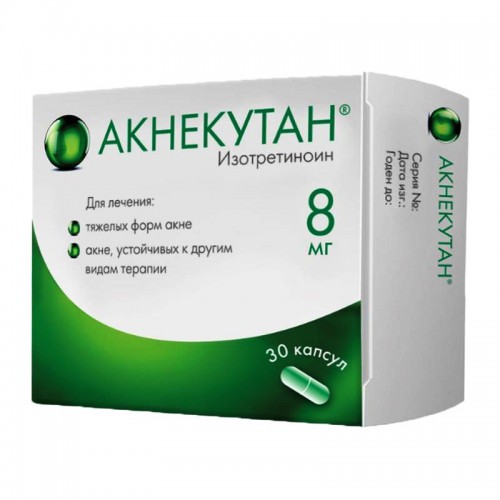
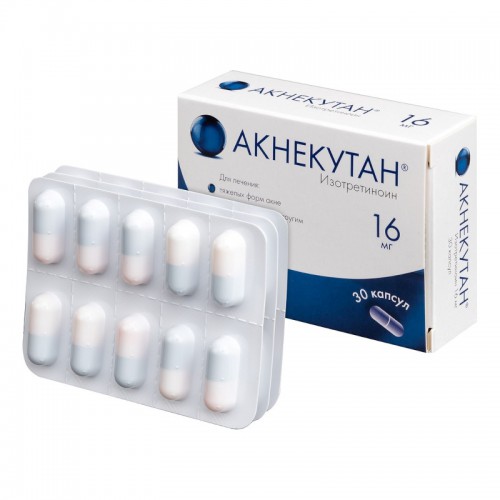
Expiration date: 09/2027
Compound
Active ingredients: 16 mg Isotretinoin 16.0 mg
Excipients: Gelucir® 50/13 (a mixture of stearic acid esters of polyethylene oxide and glycerol), purified soybean oil, Span 80® (sorbitan oleate - mixed esters of oleic acid and sorbitol).
Acnecutan 16 mg body: gelatin, titanium dioxide (E171), lid: gelatin, titanium dioxide (E171), dye iron oxide yellow (E172), indigo carmine (E132).
Description
16 mg capsules: Hard gelatin capsules No. 1, white body, green cap. The capsule contents are a yellow-orange waxy paste.
Action
Acne treatment
Pharmacodynamics
After oral administration, absorption is variable, and the bioavailability of Acnecutan is low and variable. This is due to the proportion of dissolved isotretinoin in the drug, and may also increase when taken with food. In acne patients, maximum plasma concentrations (Cmax) at steady state after taking 80 mg of isotretinoin on an empty stomach were 310 ng/ml (range 188-473 ng/ml) and were reached within 2-4 hours. The concentration of isotretinoin in plasma is 1.7 times higher than in blood due to poor penetration of isotretinoin into red blood cells. Plasma protein binding (primarily albumin) is 99.9%.
Steady-state blood isotretinoin concentrations (Css) in patients with severe acne receiving 40 mg twice daily ranged from 120 to 200 ng/mL. Concentrations of 4-oxo-isotretinoin (the main metabolite) in these patients were 2.5 times higher than those of isotretinoin.
Isotretinoin concentrations in the epidermis are half those in serum. It is metabolized to form three major biologically active metabolites: 4-oxo-isotretinoin (the major metabolite), tretinoin (all-trans retinoic acid), and 4-oxo-retinoin, as well as less significant metabolites, including glucuronides. Since isotretinoin and tretinoin are reversibly converted to each other in vivo, tretinoin metabolism is linked to that of isotretinoin. 20-30% of the isotretinoin dose is metabolized by isomerization. Enterohepatic circulation may play a significant role in the pharmacokinetics of isotretinoin in humans.
In vitro studies have shown that several CYP enzymes are involved in the conversion of isotretinoin to 4-oxo-isotretinoin and tretinoin. However, no single isoform appears to play a dominant role. Isotretinoin and its metabolites do not significantly affect CYP enzyme activity.
The terminal half-life for isotretinoin averages 19 hours. The terminal half-life for 4-oxo-isotretinoin averages 29 hours.
Isotretinoin is excreted by the kidneys and bile in approximately equal amounts. It is a natural (physiological) retinoid. Endogenous retinoid concentrations are restored approximately 2 weeks after discontinuing treatment.
Pharmacokinetics in special clinical situations
Because data on the drug's pharmacokinetics in patients with liver impairment are limited, isotretinoin is contraindicated in this group of patients. Mild to moderate renal impairment does not affect isotretinoin pharmacokinetics.
Pharmacokinetics
Isotretinoin is a stereoisomer of all-trans retinoic acid (tretinoin).
The exact mechanism of action of isotretinoin has not yet been determined, but it has been established that improvement in the clinical picture of severe acne is associated with suppression of sebaceous gland activity and a histologically confirmed reduction in their size. Sebum is the primary growth substrate for Propionibacterium acnes, so reducing sebum production inhibits bacterial colonization of the duct.
Acnecutan inhibits the proliferation of sebocytes and acts on acne, restoring the normal process of cell differentiation and stimulating regenerative processes.
In addition, the anti-inflammatory effect of isotretinoin on the skin has been proven.
Indications for use
Severe acne (nodulocystic, conglobate, and acne with the risk of scarring).
Acne that is resistant to other treatments.
Contraindications
Pregnancy, established and planned (possible teratogenic and embryotoxic effects), breastfeeding period, liver failure, hypervitaminosis A, severe hyperlipidemia, concomitant therapy with tetracyclines.
Hypersensitivity to the drug or its components. Acnecutan is not indicated for the treatment of pubertal acne and is not recommended for use in children under 12 years of age.
With caution:
Diabetes mellitus, history of depression, obesity, lipid metabolism disorders, alcoholism.
Use during pregnancy and breastfeeding
Pregnancy is an absolute contraindication for Acnecutan therapy. If pregnancy occurs despite precautions during treatment or within one month after completion of therapy, there is a very high risk of the child being born with severe birth defects.
Isotretinoin is a drug with a strong teratogenic effect. If a woman becomes pregnant while taking isotretinoin orally (at any dose, even for a short period), there is a very high risk of the baby being born with birth defects.
Acnecutan is contraindicated in women of childbearing age unless the woman's condition meets all of the following criteria:
she must suffer from severe acne that is resistant to conventional treatments,
she must be sure to understand and follow the doctor's instructions,
She should be informed by her doctor about the risk of pregnancy during treatment with Acnecutan, for one month after treatment, and urgent consultation if pregnancy is suspected.
she should be warned about the possible ineffectiveness of contraceptives,
she must confirm that she understands the nature of the precautionary measures,
she must understand the need for and continuously use effective methods of contraception for one month before treatment with Acnecutan, during treatment and for one month after its completion (see section Interaction with other medicinal products), it is advisable to use 2 different methods of contraception at the same time, including a barrier method,
She must have had a negative result from a reliable pregnancy test within 11 days before starting treatment with the drug, and a pregnancy test is strongly recommended to be performed monthly during treatment and 5 weeks after the end of therapy,
she should start treatment with Acnecutan only on the 2-3 day of the next normal menstrual cycle,
she must understand the need for mandatory visits to the doctor every month,
when treating a relapse of the disease, she must continuously use the same effective methods of contraception for one month before starting treatment with Acnecutan, during treatment and for one month after its completion, and also undergo the same reliable pregnancy test,
She must fully understand the need for precautions and confirm her understanding and willingness to use the reliable methods of contraception explained to her by her doctor.
The use of contraceptives as directed above during treatment with isotretinoin should be recommended even to women who do not normally use contraceptive methods due to infertility (except for patients who have undergone hysterectomy), amenorrhea, or who report being sexually inactive.
The physician must be sure that:
the patient suffers from severe acne (nodulocystic, conglobate acne, or acne with the risk of scarring), acne that is not responsive to other types of therapy,
a negative result from a reliable pregnancy test is obtained before starting treatment, during therapy and 5 weeks after the end of therapy, the dates and results of the pregnancy test must be documented,
the patient uses at least 1, preferably 2 effective methods of contraception, including a barrier method, for one month before starting treatment with Acnecutan, during treatment and for one month after its completion, - the patient is able to understand and fulfill all the above requirements for contraception,
the patient meets all the above conditions.
Pregnancy test
In accordance with current practice, a pregnancy test with a minimum sensitivity of 25 mIU/ml should be performed in the first 3 days of the menstrual cycle:
Before starting therapy:
To rule out possible pregnancy before starting contraception, the result and date of the initial pregnancy test should be recorded by a physician. For patients with irregular periods, the timing of the pregnancy test depends on sexual activity and should be performed three weeks after unprotected intercourse. The physician should inform the patient about contraceptive methods.
A pregnancy test is performed on the day of Acnecutan's prescription or 3 days before the patient's doctor's appointment. The doctor should record the test results. The drug can only be prescribed to patients who have been using effective contraception for at least 1 month prior to starting Acnecutan therapy.
During therapy:
The patient should see a doctor every 28 days. The need for monthly pregnancy testing is determined according to local practice and taking into account sexual activity and previous menstrual irregularities. If indicated, a pregnancy test should be performed on the day of the visit or three days before, and the results should be recorded.
End of therapy:
5 weeks after the end of therapy, a test is performed to exclude pregnancy.
A prescription for Acnecutan for a woman of childbearing potential can only be written for 30 days of treatment; continued therapy requires a new prescription from a doctor. It is recommended that a pregnancy test, prescription, and medication be filled on the same day.
Acnecutan should only be dispensed from the pharmacy within 7 days of the prescription being issued.
Side effects
Most side effects are dose-dependent. Side effects are usually reversible with dose adjustment or discontinuation of the drug, but some may persist after treatment is stopped. Symptoms associated with hypervitaminosis A include dry skin and mucous membranes, including the lips (cheilitis), nasal cavity (bleeding), larynx and pharynx (hoarseness), and eyes (conjunctivitis, reversible corneal opacity, and contact lens intolerance).
Skin and its appendages: peeling of the palms and soles, rash, pruritus, facial erythema/dermatitis, hyperhidrosis, pyogenic granuloma, paronychia, onychodystrophy, increased proliferation of granulation tissue, persistent hair thinning, reversible hair loss, fulminant acne, hirsutism, hyperpigmentation, photosensitivity, and easy skin trauma. Acne flare-ups may occur at the beginning of treatment and last for several weeks.
Musculoskeletal system: muscle pain with or without increased serum CPK levels, joint pain, hyperostosis, arthritis, calcification of ligaments and tendons, tendinitis.
Central nervous system and mental sphere: excessive fatigue, headache, increased intracranial pressure (pseudotumor cerebri: headache, nausea, vomiting, visual impairment, papilledema), seizures, rarely - depression, psychosis, suicidal thoughts. Sensory organs: xerophthalmia, isolated cases of visual acuity impairment, photophobia, impaired dark adaptation (decreased twilight vision acuity), rarely - impaired color perception (resolving after discontinuation of the drug), lenticular cataract, keratitis, blepharitis, conjunctivitis, eye irritation, optic neuritis, papilledema (as a manifestation of intracranial hypertension), hearing impairment at certain sound frequencies, difficulty wearing contact lenses.
Gastrointestinal tract: dry mouth, bleeding gums, gingivitis, nausea, diarrhea, inflammatory bowel disease (colitis, ileitis), bleeding, pancreatitis (especially with concomitant hypertriglyceridemia above 800 mg/dL). Rare cases of fatal pancreatitis have been reported. Transient and reversible increases in liver transaminase activity, and isolated cases of hepatitis have been reported. In many of these cases, changes remained within normal limits and returned to baseline values during treatment; however, in some situations, it was necessary to reduce the dose or discontinue Acnecutan.
Respiratory system: rarely - bronchospasm (more often in patients with a history of bronchial asthma).
Blood system: anemia, decreased hematocrit, leukopenia, neutropenia, increased or decreased platelet count, increased ESR.
Laboratory findings include hypertriglyceridemia, hypercholesterolemia, hyperuricemia, decreased high-density lipoprotein levels, and, rarely, hyperglycemia. Cases of new-onset diabetes mellitus have been reported during treatment with Acnecutan. In some patients, particularly those engaged in intense physical activity, isolated cases of increased serum CPK activity have been reported.
Immune system: local or systemic infections caused by gram-positive pathogens (Staphylococcus aureus).
Other: lymphadenopathy, hematuria, proteinuria, vasculitis (Wegener's granulomatosis, allergic vasculitis), systemic hypersensitivity reactions, glomerulonephritis.
Teratogenic and embryotoxic effects: congenital malformations - hydro- and microcephaly, underdevelopment of the cranial nerves, microphthalmia, malformations of the cardiovascular system, parathyroid glands, skeletal formation disorders - underdevelopment of the finger phalanges, skull, cervical vertebrae, femur, ankles, forearm bones, facial skull, cleft palate, low position of the auricles, underdevelopment of the auricles, underdevelopment or complete absence of the external auditory canal, hernia of the brain and spinal cord, bone adhesions, fusion of the fingers and toes, developmental disorders of the thymus gland, fetal death in the perinatal period, premature birth, miscarriages), premature closure of the epiphyseal growth zones, in an experiment on animals - pheochromocytoma.
Interaction
Tetracycline antibiotics and corticosteroids reduce the effectiveness of the drug. Concomitant use with drugs that increase photosensitivity (including sulfonamides, tetracyclines, and thiazide diuretics) increases the risk of sunburn.
Concomitant use with other retinoids (including acitretin, tretinoin, retinol, tazarotene, adapalene) increases the risk of hypervitaminosis A.
Isotretinoin may reduce the effectiveness of progesterone medications, so contraceptives containing low doses of progesterone should not be used.
Concomitant use with topical keratolytic agents for acne treatment is not recommended due to the potential for increased local irritation. Since tetracyclines increase the risk of increased intracranial pressure, concomitant use with isotretinoin is contraindicated.
Method of administration and dosage
Orally, preferably during meals, 1-2 times a day.
The therapeutic efficacy of Acnecutan and its side effects depend on the dose and vary among patients. This necessitates individual dosage adjustment during treatment.
The starting dose of Acnecutan is 0.4 mg/kg per day, in some cases up to 0.8 mg/kg per day. For severe cases or with corpora acne, a dose of up to 2 mg/kg per day may be required.
The optimal cumulative dose is 100-120 mg/kg. Complete remission is usually achieved within 16-24 weeks. If the recommended dose is poorly tolerated, treatment can be continued at a lower dose for a longer period. In most patients, acne completely resolves after a single course of treatment.
In case of relapse, a repeat course of treatment may be administered at the same daily and cumulative dose. A repeat course is prescribed no earlier than 8 weeks after the first, as improvement may be delayed.
In severe chronic renal failure, the initial dose should be reduced to 8 mg/day.
Overdose
In case of overdose, signs of hypervitaminosis A may appear. Gastric lavage may be necessary in the first few hours after an overdose.
Special instructions
Monitoring liver function and liver enzymes is recommended before treatment, 1 month after initiation, and then every 3 months or as indicated. Transient and reversible increases in liver transaminases have been observed, but in most cases they are within the normal range. If liver transaminase levels exceed the normal range, the drug dose should be reduced or discontinued. Fasting serum lipid levels should also be determined before treatment, 1 month after initiation, and then every 3 months or as indicated. Lipid levels usually normalize after dose reduction or drug discontinuation, as well as with dietary intervention. Clinically significant increases in triglyceride levels should be monitored, as elevations above 800 mg/dL or 9 mmol/L may be associated with the development of acute pancreatitis, which can be fatal.
If hypertriglyceridemia or symptoms of pancreatitis persist, Acnecutan should be discontinued. In rare cases, depression, psychotic symptoms, and, very rarely, suicidal attempts have been reported in patients receiving Acnecutan. Although a causal relationship with the drug has not been established, particular caution should be exercised in patients with a history of depression, and all patients should be monitored for the emergence of depression during treatment, with referral to an appropriate specialist if necessary. However, discontinuing Acnecutan may not result in resolution of symptoms, and further monitoring and treatment by a specialist may be necessary.
In rare cases, acne may worsen at the beginning of therapy, but this usually resolves within 7-10 days without adjusting the dosage.
When prescribing a drug to any patient, the balance of possible benefits and risks should be carefully assessed beforehand.
Patients receiving Acnecutan are advised to use a moisturizing body ointment or cream, lip balm to reduce dryness of the skin and mucous membranes at the beginning of therapy.
While taking Acnecutan, muscle and joint pain and an increase in serum creatinine phosphokinase are possible, which may be accompanied by a decrease in tolerance to intense physical activity.
Deep chemical dermabrasion and laser treatment should be avoided in patients receiving Acnecutan, as well as for 5-6 months after completion of treatment, due to the potential for increased scarring in atypical areas and the development of hyper- and hypopigmentation. Waxing should be avoided during and for 6 months after treatment with Acnecutan due to the risk of epidermal detachment, scarring, and dermatitis. Since some patients may experience decreased night vision, which may persist after completion of therapy, patients should be informed of this possibility and advised to exercise caution when driving at night. Visual acuity should be closely monitored. Dry conjunctiva, corneal opacities, decreased night vision, and keratitis usually resolve after discontinuation of the drug. Moisturizing eye ointment or artificial tears can be used for dry mucous membranes. Patients with dry conjunctiva should be monitored for the development of keratitis. Patients with vision complaints should be referred to an ophthalmologist, and the discontinuation of Acnecutan should be considered. If contact lenses are intolerant, glasses should be worn during treatment. Exposure to sunlight and UV radiation should be limited. If necessary, use sunscreen with a high SPF of at least 15.
Rare cases of benign intracranial hypertension (pseudotumor cerebri) have been reported, including with concomitant use with tetracyclines. In such patients, Acnecutan should be discontinued immediately. Inflammatory bowel disease may develop during Acnecutan therapy. In patients with severe hemorrhagic diarrhea, Acnecutan should be discontinued immediately.
Rare cases of anaphylactic reactions have been reported, occurring only after previous topical use of retinoids. Severe allergic reactions require discontinuation of the drug and close monitoring of the patient.
High-risk patients (those with diabetes, obesity, chronic alcoholism, or lipid metabolism disorders) may require more frequent laboratory monitoring of glucose and lipid levels while receiving Acnecutan. If diabetes is present or suspected, more frequent blood glucose monitoring is recommended.
Patients with diabetes are advised to monitor their blood glucose levels more frequently.
During the treatment period, caution should be exercised when driving vehicles and engaging in other potentially hazardous activities that require increased concentration and quick psychomotor reactions (when taking the first dose).
During treatment and for 30 days after its completion, blood collection from potential donors should be strictly avoided to completely eliminate the possibility of blood being exposed to pregnant patients (high risk of teratogenic and embryotoxic effects). Available as 8 mg and 16 mg capsules. 10 or 14 capsules per PVC blister, covered with aluminum foil.
Blisters-10-N2, N3, N5, N6, N9, N10, blisters-14-N1, N2, N4, N7 in a cardboard box along with instructions for use.
Release form
Dosage form: 16 mg capsules. 30 capsules in a PVC blister, covered with aluminum foil.
The blisters are packed in a cardboard box along with instructions for use.
Storage conditions
In a dry, dark place at a temperature not exceeding 25 C
Best before date
2 years. Do not use after expiration date.
Manufacturer and organization accepting consumer complaints
Marketing Authorization Holder: JADRAN JSC Gapensky Laboratories, 51000, Pulač n/n, Rijeka, Croatia Manufacturer: SMB TECHNOLOGY S.A., Rue du Parc Industriel 39-6900 Marche-en-Famenne, Belgium Quality Control Officer: JADRAN JSC Gapensky Laboratories, 51000, Pulač n/n, Rijeka, Croatia Any complaints regarding the quality of the product should be addressed to the Representative Office of JADRAN JSC Gapensky Laboratories in Russia: 119330, Moscow, Lomonosovskiy pr-t, 38, of.Z, 30,