Expiration date: 08/2028
Compound
Composition per 1 tablet:
active substance: finasteride, 5 mg;
excipients:
Tablet core: magnesium stearate 0.7500 mg; talc 4.5000 mg; sodium carboxymethyl starch (type A) 7.5000 mg; pregelatinized starch 15.0000 mg; microcrystalline cellulose 15.0000 mg; lactose monohydrate 102.2500 mg.
Shell: titanium dioxide CI77891 EEC 171 0.1881 mg; lactose monohydrate 0.3809 mg; macrogol-6000 0.6214 mg; hyprolose 1.9048 mg; hypromellose 1.9048 mg.
Tamsulosin Composition per 1 capsule:
active ingredient: tamsulosin hydrochloride, 0.4 mg;
excipients:
calcium stearate 0.800 mg; triethyl citrate 1.100 mg; talc 2.500 mg; methacrylic acid and ethyl acrylate copolymer (1:1) 43.800 mg, also containing polysorbate-80 1.000 mg, sodium lauryl sulfate 0.300 mg; microcrystalline cellulose 281.400 mg.
Composition of the hard gelatin capsule
Cap: dye iron oxide yellow CI 77492 E172 0.2000%, titanium dioxide CI 77891 E171 0.3333%, dye iron oxide black CI 77499 E172 0.5300%, dye iron oxide red CI 77491 E172 0.9300%, gelatin up to 100.000%.
Body: iron oxide red CI 77491 E172 0.010%, iron oxide black CI 77499 E172 0.0100%, iron oxide yellow CI 77492 E172 0.1714%, titanium dioxide CI 77891 E171 3.000%, gelatin up to 100.000%.
Dosage form
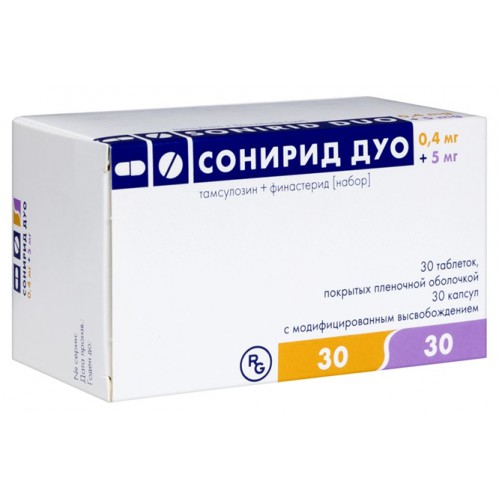
set of tablets and capsules
Description
Tamsulosin:
Hard gelatin capsules, size #2; cap: opaque, brown
; body: opaque, brownish-yellow.
Capsule contents: white or off-white pellets.
Finasteride:
Film-coated tablets, white or off-white,
triangular with rounded ends, slightly biconvex, nearly odorless,
debossed with "RG" on one side.
Pharmacodynamics
Soniride Duo is indicated for the treatment and symptom control of benign prostatic hyperplasia (BPH) when combination therapy with tamsulosin and finasteride is required in order to:
- achieve prostate size regression, improve urination and reduce lower urinary tract symptoms caused by BPH;
- slow down clinical progression of the disease and reduce the incidence of acute urinary retention and the need for surgical treatment, including transurethral resection of the prostate (TURP) and prostatectomy; Soniride Duo can only be used in cases of prostate enlargement (prostate volume greater than 40 cm3). With such prostate enlargement, combination therapy alleviates BPH symptoms and slows clinical progression of the disease more effectively than monotherapy with finasteride or an alpha-1-adrenergic blocker.
- The drug can only be used to treat men.
Pharmacodynamics
Tamsulosin pharmacodynamics
Tamsulosin selectively and competitively blocks postsynaptic alpha-1-adrenergic receptors located in the smooth muscle of the prostate, bladder neck, and prostatic urethra (alpha-1A subtype), as well as alpha-1-adrenergic receptors located primarily in the body of the bladder (alpha-ID subtype). This leads to a decrease in smooth muscle tone in the prostate, bladder neck, and prostatic urethra and an improvement in detrusor function. This reduces the symptoms of obstruction and irritation associated with benign prostatic hyperplasia. The therapeutic effect typically develops within 2 weeks of starting treatment, although some patients experience a reduction in symptom severity after the first dose. Tamsulosin's affinity for alpha-1A adrenergic receptors is 20 times greater than its ability to interact with alpha-1B adrenergic receptors, which are located in vascular smooth muscle. Due to this high selectivity, the drug does not cause any clinically significant decrease in systemic blood pressure (BP) in either hypertensive or normal-baseline patients.
Finasteride is a synthetic 4-azasteroid, a specific inhibitor of the intracellular enzyme 5-alpha-reductase type II. The latter converts testosterone into a more active androgen, 5-alpha-dihydrotestosterone (DHT). Normal function and growth of the prostate gland, including its hypertrophied tissue, depend on the conversion of testosterone to DHT. Finasteride has no effect on androgen receptors. In healthy volunteers, prostate cell proliferation and apoptosis
Balanced by the interaction of factors that inhibit and stimulate growth. Although the etiological factors that cause prostatic hyperplasia at the molecular level are not yet known, DHT likely plays a role in this process. Specific inhibitors of type II 5-alpha-reductase reduce DHT concentrations in the prostate and promote the regression of prostatic hyperplasia. According to clinical studies, treatment with finasteride rapidly reduces plasma DHT concentrations by 70%, leading to a reduction in prostate volume. With continuous administration, statistically significant effects are recorded after 3 months (a reduction in gland volume by approximately 20%) and 7 months (a reduction in the severity of symptoms associated with prostatic hyperplasia).
There are two types of 5-alpha-reductase in the human body: I and II. Their tissue distribution varies: type II isoenzyme is found in the prostate, testicles and their epididymis, glans penis, scrotum, seminal vesicles, liver, and chest; type I is found mainly in the scalp, back, and chest skin, sebaceous glands, liver, adrenal glands, and kidneys. Finasteride primarily inhibits type II isoenzyme, which is responsible for the majority of DHT in the blood. A single dose of finasteride rapidly and significantly alters plasma DHT concentrations. A single dose of 5 mg of finasteride reduces plasma DHT concentrations by 75%, reaching their minimum levels within 24 hours and then returning to baseline within 7 days. Finasteride maintains its effectiveness with repeated administration. Finasteride reduces DHT concentrations in the prostate itself by <15% and provides a corresponding increase in prostate testosterone levels. Compared with surgical or chemical castration, treatment with finasteride is associated with a significantly greater reduction in prostate DHT levels.
Prostate-specific antigen (PSA) is a sensitive and specific androgen-dependent marker for prostate cancer. In most cases, after several months of treatment with finasteride, PSA levels rapidly decline, eventually returning to low levels.
After one year of finasteride treatment at a dose of 5 mg, the average PSA level decreases by 50%.
Finasteride has no affinity for androgen receptors and has no other hormonal effects. Following the discovery of 5-alpha-reductase and the description of 5-alpha-reductase deficiency syndrome type II (male-onset hermaphroditism), the role of androgens in benign prostatic hyperplasia was re-evaluated. Prostate development depends on DHT, a potent androgen. With 5-alpha-reductase deficiency and normal or high testosterone levels in adulthood, prostate atrophy is observed. DHT activates androgen receptors, forming dimers upon binding to them. These dimers, when bound to DNA, directly or indirectly promote cell proliferation by altering the expression of genes responsible for proliferation and apoptosis. In an intact prostate, apoptosis and proliferation are balanced. Although the factors that trigger prostate hyperplasia at the molecular level remain unknown, the role of DHT is highly probable. Specific inhibitors of 5-alpha-reductase type II can reduce DHT concentrations in the prostate and promote the regression of prostate hyperplasia. Significant lethality was observed in mice and rats of both sexes when the former were fed a single dose of 1500 mg/m2 (500 mg/kg), and the latter - 2360 mg/m2 (400 mg/kg for females) and 5900 mg/m2 (1000 mg/kg for males). Low doses of the drug fed to pregnant rats caused genital malformations in male offspring.
Pharmacokinetics
Tamsulosin
Absorption: Tamsulosin is absorbed in the small intestine, with bioavailability in the fasting state being almost 100%. Absorption is reduced when tamsulosin is taken with food. To achieve equal absorption, the drug should be taken daily at the dose indicated in the instructions, after breakfast. When taking one prolonged-release capsule of 0.4 mg after a meal, the maximum concentration (Cmax) of the drug in plasma is reached in approximately 6 hours. With repeated administration, steady-state concentration is reached by day 5, when the maximum concentration of the drug in plasma is approximately 2-3 times higher than with a single dose. Although these parameters were evaluated in elderly patients, they are assumed to be similar in younger patients. Individual fluctuations in plasma drug concentrations may occur with single and multiple doses.
Distribution: Approximately 99% of tamsulosin is bound to plasma proteins; the volume of distribution is small (about 0.2 L/kg).
Metabolism: Tamsulosin is slowly metabolized, with a minor first-pass effect. Tamsulosin is slowly biotransformed in the liver to form pharmacologically active metabolites that retain high selectivity for alpha-adrenergic receptors. Most of the active substance is present in the blood unchanged. In rats, slight microsomal induction induced by tamsulosin was observed. None of the metabolites exhibited greater activity than tamsulosin.
Elimination: Tamsulosin and its metabolites are primarily excreted by the kidneys, with approximately 9% of the administered dose being excreted unchanged. The plasma half-life of the drug was 10 hours after a single dose of 0.4 mg capsule, compared to 13 hours after multiple doses, with a terminal half-life of 22 hours. No dose adjustment is required in patients with renal disease.
Finasteride
Absorption: Rapidly absorbed from the gastrointestinal tract, reaching a maximum plasma concentration of 37 ng/ml within 2 hours. Absorption in the gastrointestinal tract is complete 6-8 hours after administration. Food intake does not affect the absorption of finasteride. The bioavailability of finasteride after oral administration is approximately 80%.
Distribution: 90% of circulating finasteride is bound to plasma proteins and does not have a damaging effect in kidney diseases. Finasteride penetrates the blood-brain barrier and is distributed in small amounts in the seminal fluid of patients. The volume of distribution is 76±14 L.
Metabolism: Finasteride is actively metabolized in the liver via oxidative biotransformation. Two of the five metabolites of finasteride have weak activity and are responsible for 20% of the total inhibition of 5-alpha-reductase.
Excretion: The average half-life of finasteride is 6 hours (4-12 hours), in men over 70 years of age - 8 hours (6-15 hours). When using labeled finasteride, approximately 39% (32-49%) of the administered dose was excreted in the urine as metabolites. Unchanged finasteride was practically not detected in the urine. Approximately 57% (51-64%) of the total dose is excreted in the feces. In patients with impaired renal function (creatinine clearance > 9 ml/min), no differences in finasteride excretion were observed. The concentration of finasteride in semen ranges from undetectable (< 1 ng/ml) to 21 ng/ml.
Long-term administration of 5 mg/day for 3-7 months reduces the concentration of DHT in the blood serum by 70%.
Pharmacokinetics in specific patient groups: Finasteride is eliminated slightly more slowly in elderly patients, but this is not clinically significant and does not require dosage adjustment. This also applies to patients with renal impairment, as the decreased renal excretion of metabolites is compensated for by increased fecal excretion. Finasteride pharmacokinetics in patients with hepatic impairment have not been studied. Since finasteride is extensively metabolized in the liver, additional monitoring is necessary in patients with liver disease.
Indications for use
Treatment and control of symptoms of benign prostatic hyperplasia (BPH).
Contraindications
- hypersensitivity to the active substances or excipients;
- history of postural hypotension;
- severe liver failure;
- impaired renal function (plasma creatinine concentration >2 mg/dl);
- galactose intolerance, lactase deficiency or glucose-galactose malabsorption;
- women and children.
Use during pregnancy and breastfeeding
Soniride Duo should not be used by women. Pregnant women and women of childbearing age should avoid handling crushed or broken finasteride tablets, as well as contact with the semen of men taking finasteride (use a condom).
Use in children
Contraindicated in children.
Side effects
Adverse reactions are defined as common >1/100 to <1/10; uncommon (>1/1000 to <1/100); rare (>1/10000 to <1/1000); very rare (<1/10000).
Adverse reactions of tamsulosin monotherapy Nervous system disorders:
Common: dizziness;
Uncommon: headache;
Rare: syncope.
Cardiovascular system disorders:
Uncommon: postural hypotension, tachycardia.
Respiratory, thoracic and mediastinal disorders: Uncommon: rhinitis;
Gastrointestinal disorders:
Uncommon: constipation, diarrhea, nausea, vomiting.
Skin and subcutaneous tissue disorders:
Uncommon: rash, pruritus, urticaria;
Rare: angioedema.
From the reproductive system:
Uncommon: retrograde ejaculation;
Rare: priapism.
Adverse reactions of finasteride monotherapy From the immune system Uncommon: hypersensitivity.
From the organ of vision Uncommon: lens clouding.
From the gastrointestinal tract Common: abdominal pain.
From the skin and subcutaneous tissue
Uncommon: rash.
From the reproductive system and mammary glands:
Common: erectile dysfunction, ejaculation disorder, decreased ejaculate volume, decreased libido;
Uncommon: breast tenderness, breast enlargement, testicular pain.
The following additional adverse reactions have been described during post-marketing surveillance (no data on the frequency of adverse reactions):
hypersensitivity reactions, including itching, urticaria, swelling of the lips and face. Adverse Reactions of Combination Therapy:
In patients receiving combination therapy (finasteride and an alpha-1-adrenergic blocker), the same adverse reactions have been reported, occurring with the same frequency as with monotherapy with finasteride and an alpha-1-adrenergic blocker. However, the following exceptions have been identified: erectile dysfunction and ejaculatory dysfunction were observed more frequently with combination therapy, while disease progression (including worsening of BPH symptoms or the need for surgical treatment) was observed more frequently with monotherapy.
Interaction
In vitro studies of liver microsomal fractions (a model of drug metabolism by the cytochrome P450 enzymatic system) showed that tamsulosin does not interact pharmacokinetically with finasteride during hepatic metabolism.
Additional interactions of tamsulosin with other medicinal products and other interactions:
No interactions were observed with the concomitant use of tamsulosin and atenolol, enalapril, nifedipine, or theophylline. Concomitant use with cimetidine may increase plasma tamsulosin concentrations, while furosemide causes a decrease. However, no dosage adjustment is required, as tamsulosin concentrations remain within the normal range. In vitro, diazepam, propranolol, trichlormethiazide, chlormadinone, amitriptyline, diclofenac, glibenclamide, simvastatin, and warfarin do not alter the free fraction of tamsulosin in human plasma. Tamsulosin also does not alter the free fraction of diazepam, propranolol, trichlormethiazide, and chlormadinone. In vitro studies of hepatic microsomal fractions (a model of drug metabolism by the cytochrome P450 enzymatic system) showed no interactions with amitriptyline, salbutamol, glibenclamide, and finasteride at the level of hepatic metabolism. However, diclofenac and warfarin may increase the rate of tamsulosin elimination. There is a theoretical possibility that concomitant administration with tamsulosin may enhance the hypotensive effect of other drugs, such as general anesthetics or other alpha-1-blockers.
Additional interactions of Finasteride with other medicinal products and other interactions
No clinically significant interactions have been identified with concomitant administration of finasteride with the following drugs: warfarin, angiotensin-converting enzyme inhibitors, alpha-1-blockers, theophylline, acetylsalicylic acid, paracetamol, beta-blockers, diuretics, nitrates, calcium channel blockers, anticonvulsants, nonsteroidal anti-inflammatory drugs (NSAIDs), benzodiazepines, quinolones, H2H receptor antagonists, 3-hydroxy-3-methyl-glutaryl-coenzyme A reductase (HMG-CoA) inhibitors.
Method of administration and dosage
Soniride Duo contains 0.4 mg tamsulosin in modified-release capsules and 5 mg finasteride in film-coated tablets. The drugs are intended for daily use. The daily dose of Soniride Duo includes one 0.4 mg tamsulosin modified-release capsule and one 5 mg finasteride film-coated tablet.
Tamsulosin 0.4 mg modified-release capsules should be taken at the same time of day, after meals. Capsules should be swallowed whole, without breaking or chewing, as this may disrupt the sustained release of the active substance.
For the full therapeutic effect, long-term use of Soniride Duo is necessary. If adverse reactions occur, the patient can be transferred to finasteride monotherapy; However, it is recommended to return to the combination regimen if the severity of BPH symptoms increases.
Overdose
There are no reports of concomitant overdose of finasteride and tamsulosin.
There are no clinical data on tamsulosin overdose. Theoretically, acute overdose of tamsulosin may cause arterial hypotension, which may lead to cardiovascular disorders. To restore blood pressure and heart rate, the patient should be placed in a comfortable position; if necessary, plasma expanders and, depending on the patient's condition, vasopressors should be used. Monitoring of renal function is recommended. Dialysis is not indicated due to significant binding of tamsulosin to plasma proteins. To reduce drug absorption, it is advisable to induce vomiting. Gastric lavage after ingestion of a large amount of the drug should be performed together with the administration of activated charcoal and an osmotic laxative (e.g., sodium sulfate).
Finasteride Overdose: A single dose of 400 mg of finasteride and multiple doses of up to 80 mg/day for 3 months have not revealed any adverse reactions. In case of overdose, no specific treatment is required.
Special instructions
When assessing prostate-specific antigen (PSA) levels, it is important to consider that PSA levels decrease during treatment with finasteride. In most patients, PSA levels decline rapidly during the first month of treatment and then stabilize at a new baseline. This "post-therapy baseline" is approximately half the pre-therapy value. Therefore, in typical cases of treatment with finasteride for six months or more, the PSA level should be doubled to compare with normal values in patients not taking finasteride. No other differences in routine laboratory parameters were observed between patients receiving placebo or finasteride.
Before starting treatment with Soniride Duo, patients should be examined to exclude other conditions that cause the same symptoms as BPH. A digital rectal examination and, if necessary, PSA testing should be performed before and regularly during treatment.
Patients with a large residual urine volume and/or severe urinary difficulty should be assessed for obstructive uropathy.
Precautions for use of tamsulosin:
- As with other alpha-1-adrenergic blockers, blood pressure may decrease during treatment with tamsulosin, rarely leading to syncope. At the first sign of postural hypotension (eg, dizziness, weakness), the patient should be seated or laid down until symptoms completely resolve.
- Intraoperative floppy iris syndrome (FIPS, a variant of small pupil syndrome) has been observed during cataract surgery in some patients taking tamsulosin. Intraoperative FIPS may increase the incidence of surgical complications. It is not recommended to initiate tamsulosin treatment in patients scheduled for cataract surgery. Discontinuing tamsulosin 1-2 weeks before surgery usually reduces the risk; however, the optimal timing for discontinuing it has not yet been established. To prevent the development of intraoperative floppy iris syndrome, the surgeon and ophthalmologists should determine preoperatively whether the patient has previously taken or is currently taking tamsulosin. This will allow appropriate measures to be taken during planning and surgery.
Precautions for the use of finasteride:
- There are no data on the possibility of finasteride being absorbed by manually breaking a tablet or during sexual intercourse through contact with the semen of a man taking finasteride. Therefore, pregnant women and women of childbearing potential are advised not to break tablets manually, avoid contact with crushed or broken tablets, and avoid contact with the semen of a man taking finasteride. Since the duration of the presence of finasteride in a man's semen after stopping treatment is unknown, such precautions should be observed for 2 months after the end of treatment.
- Finasteride tablets contain lactose monohydrate. Patients with rare hereditary problems of galactose intolerance, the Lapp lactase deficiency, or glucose-galactose malabsorption should not take this medicine. Patients with lactose intolerance should note that the medicine contains 102.6 mg of lactose monohydrate.
The Effect of Finasteride on PSA Levels and Prostate Cancer Diagnosis Before starting treatment and periodically during treatment with finasteride, a digital rectal examination should be performed and, if necessary, prostate-specific antigen (PSA) levels should be determined. There is significant overlap in PSA levels in men with and without prostate cancer. Therefore, in men with BPH, a PSA value within the normal range due to finasteride use does not exclude the presence of prostate cancer.
Finasteride use reduces serum PSA levels by approximately 50% in patients with BPH, even in the presence of prostate cancer. The decrease in PSA levels is observed across the entire range of its values and may vary among patients. When assessing the PSA level, it is important to keep in mind that a decrease in plasma PSA in patients with BPH taking finasteride does not exclude the presence of prostate cancer. In patients taking finasteride for 6 months or more, the PSA value should be doubled to compare with normal values in patients not taking finasteride. This adjustment preserves the sensitivity and specificity of PSA determination and enables the diagnosis of prostate cancer.
If PSA levels are persistently elevated in men taking finasteride, a thorough examination should be performed. However, the possibility of noncompliance with the finasteride dosing regimen cannot be ruled out.
Finasteride does not significantly reduce the proportion of free PSA or the free-to-total PSA ratio; this ratio remains unchanged during treatment with finasteride. No adjustment is required when determining the proportion of free PSA for the diagnosis of prostate cancer.
Impact on the ability to drive vehicles and operate machinery
No similar effects have been observed with finasteride. Such effects with tamsulosin have not been specifically studied. However, the possibility of drowsiness, blurred vision, dizziness, and fainting in some patients should be considered. Therefore, they should temporarily refrain from driving or operating machinery with an increased risk of injury.
Release form
5 film-coated tablets (finasteride) and 5 modified-release capsules (tamsulosin) in a PVC/PVDC/A1 blister.
6 blisters per cardboard box along with instructions for medical use.
(5) - PVC/PVDC/Al blister (6) /5 film-coated tablets (finasteride) and 5 modified-release capsules (tamsulosin) in a PVC/PVDC/Al blister. 6 blisters in a cardboard box./ - cardboard boxes
Conditions of dispensing from pharmacies
By prescription
Storage conditions
Store at a temperature of 15 to 30°C.
Keep out of reach of children!
Best before date
3 years. Do not use the product after the expiration date.
Manufacturer and organization accepting consumer complaints
GEDEON RICHTER