Expiration date: 03/2029
Method of administration and dosage
Always take this medicine exactly as your doctor tells you. If you are unsure, consult your doctor.
Dosage regimen
1 tablet (5 mg) 1 time per day.
Your doctor may prescribe finasteride along with another medication, such as doxazosin, to control BPH.
How and when to take Finasteride
Orally, regardless of food intake.
Film-coated tablets should be swallowed whole and should not be divided or crushed.
If you forget to take Finasteride
If you forget to take Finasteride, you can take it as soon as you remember, unless it's almost time for your next dose. Do not take a double dose to make up for a missed dose.
How long should I take Finasteride?
After starting Finasteride, your condition may improve quickly. However, it may take at least 6 months to achieve the full effect of treatment. Continue taking the pills until your doctor tells you to stop.
If you have any further questions about the use of this medicine, please ask your doctor.
Indications
The drug Finasteride is indicated for use in men:
- Treatment and control of benign prostatic hyperplasia (BPH), prevention of urological complications in order to:
- reducing the risk of acute urinary retention;
- reducing the risk of the need for surgical interventions, including transurethral resection of the prostate gland and prostatectomy.
- Treatment to reduce the size of an enlarged prostate gland, improve urine flow and reduce the severity of symptoms associated with BPH.
- In combination with the alpha-blocker doxazosin to reduce the risk of progression of symptoms associated with BPH.
Compound
The active ingredient is finasteride.
Each film-coated tablet contains 5 mg of finasteride.
The excipients are:
Lactose monohydrate
Microcrystalline cellulose (MCC-102)
Partially pregelatinized starch
Sodium carboxymethyl starch (type A)
Magnesium stearate
Docusate sodium
Shell composition:
Hypromellose
Titanium dioxide (E171)
Macrogol-4000
Talc
Finasteride contains lactose (see section 2).
Contraindications
Do not take Finasteride:
- if you are allergic to finasteride or any of the other ingredients of this medicine listed in section 6 of this leaflet.
- if you have rare hereditary problems of galactose intolerance, the Lapp lactase deficiency or glucose-galactose malabsorption.
- if you are under 18 years of age.
According to its registered indication, Finasteride is not indicated for use in women.
Special instructions
Before using Finasteride, consult your doctor.
This is especially important:
- If your sexual partner is pregnant or planning to become pregnant, you must use a barrier method of contraception during treatment with Finasteride. This is because small amounts of the drug may pass into your semen, which may affect the normal development of the external genitalia in a male fetus;
- if you are about to have a blood test for prostate-specific antigen (PSA). This is because taking Finasteride may affect the results of this test;
- if you have liver failure or if you have a large volume of residual urine and/or significantly reduced urine flow. This is associated with the risk of developing possible complications;
- if you are an elderly patient.
If you are not sure whether any of these apply to you, talk to your doctor before you start taking Finasteride.
Cases of breast cancer in men have been reported with the use of finasteride. If you experience any changes in your breasts during treatment with finasteride, such as swelling, pain, enlargement, or nipple discharge, notify your doctor immediately.
Mood changes, including depressed mood, depression, and, rarely, suicidal ideation, have been reported in patients taking finasteride. If you experience any of these symptoms while taking finasteride, notify your doctor immediately.
Children and teenagers
Finasteride is not intended for use in children under 18 years of age.
Finasteride contains lactose.
If you have an intolerance to some sugars, consult your doctor before taking this medicine.
Packaging and release form
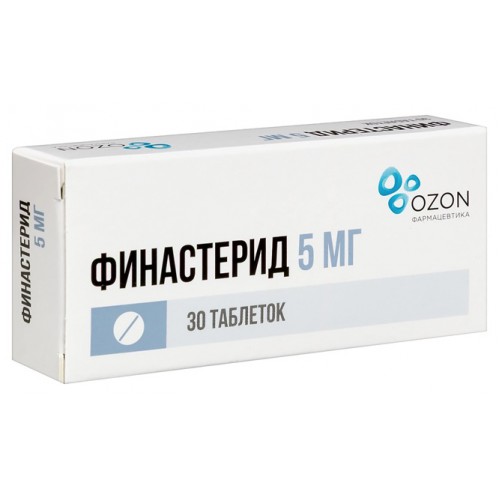
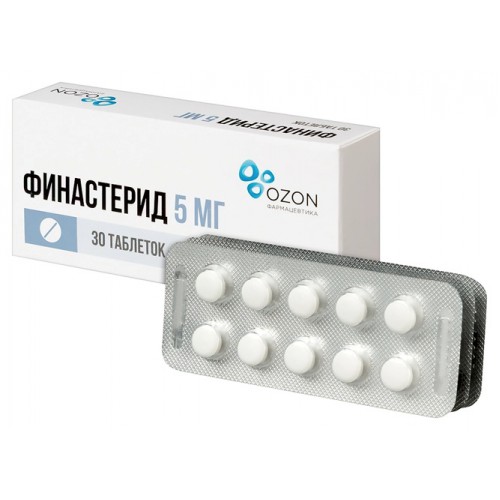
Film-coated tablets, 5 mg - 30 or 90 pcs per pack, with instructions for medical use (package insert) placed in a cardboard box (pack).
Side effects
Possible adverse reactions
Like all medicines, this medicine can cause side effects, although not everybody gets them.
Contact your doctor immediately if you notice any of the following serious side effects - you may need emergency medical attention:
Allergic reactions, which may include itchy skin, urticaria (intensely itchy blisters on the skin), and angioedema (swelling of the lips, tongue, larynx, and face, sometimes with difficulty breathing).
Other adverse reactions
Common (may affect up to 1 in 10 people)
- Lack of erection (impotence);
- Decreased libido (decreased sexual desire);
- Decreased volume of seminal fluid (ejaculate).
Uncommon (may affect up to 1 in 100 people)
- Ejaculation disorder;
- Soreness of the mammary glands;
- Enlargement of the mammary glands (gynecomastia);
- Skin rash.
Frequency unknown (frequency cannot be estimated from the available data)
- Depression (low mood);
- Decreased libido that persists after discontinuation of treatment;
- Feeling of fear;
- Feeling of heartbeat;
- Increased activity of liver enzymes;
- Pain in the testicles;
- Erectile dysfunction that persists after discontinuation of treatment;
- The appearance of blood in the seminal fluid (hematospermia);
- Male infertility and/or decreased quality of seminal fluid.
You should report any changes in your breast tissue, such as swelling, pain, enlargement, or discharge from your nipples, to your doctor promptly, as these may be signs of a serious condition, such as breast cancer.
Reporting adverse reactions
If you experience any adverse reactions, consult your doctor. This advice also applies to any adverse reactions not listed in the package leaflet. You can also report adverse reactions directly (see below). By reporting adverse reactions, you help provide more information about the safety of this medicine.
Pharmacotherapeutic group
agents used in urology; agents for the treatment of benign prostatic hyperplasia; testosterone-5-alpha-reductase inhibitors
Interaction with other drugs
Tell your doctor if you are taking, have recently taken, or might take any other medicines.
No clinically significant adverse interactions of finasteride with other drugs have been identified.
Impact on the ability to drive a car and operate other machinery
Finasteride does not affect the ability to drive or operate machinery.
Use during pregnancy and breastfeeding
Finasteride is not indicated for use in women (see Contraindications).
Women who are pregnant or may become pregnant should not handle crushed finasteride tablets (whole tablets are coated to prevent contact with the drug) because finasteride may interfere with the normal development of the external genitalia in a male fetus.
Pharmacodynamics
What is Finasteride and what is it used for?
Finasteride belongs to a group of medications called 5-alpha-reductase inhibitors. Finasteride is used in adult men for prostate enlargement, known as benign prostatic hyperplasia (BPH). This condition is accompanied by urinary disturbances: difficulty urinating (weak urine stream), dribbling urine at the end of urination, urgent urination, and increased frequency of urination at night and during the day. Finasteride can reduce prostate size and facilitate urination.
The mode of action of the drug Finasteride
Finasteride is an inhibitor of 5-alpha-reductase, an intracellular enzyme that converts the sex hormone testosterone into the more active dihydrotestosterone (DHT). In BPH, its increase depends on the conversion of testosterone to DHT in the prostate gland. Finasteride effectively reduces DHT concentrations in both the blood and prostate tissue. Suppression of DHT formation is accompanied by a decrease in prostate size, an increase in maximum urine flow rate, and a reduction in the severity of BPH-related symptoms.
If there is no improvement or you feel worse, you should consult a doctor.
Storage temperature
from 2℃ to 25℃
Dosage form
Round, biconvex, film-coated tablets, white to off-white. A cross-section reveals a white to off-white tablet core.
Overdose
If you take more Finasteride than you should
If you take more Finasteride than you should, or if children accidentally take the medicine, tell your doctor right away.