Expiration date: 03/2029
Dosage form
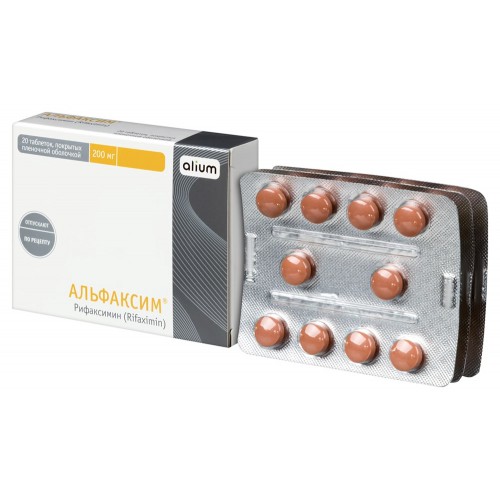
Round, biconvex, film-coated tablets of a brownish-pink color. The core is orange when cross-sectioned.
Compound
1 film-coated tablet contains:
Active ingredient: rifaximin - 200 mg;
Excipients: microcrystalline cellulose, type 102, colloidal silicon dioxide (aerosil) hydrophobic, sodium carboxymethyl starch (sodium starch glycolate), talc, magnesium stearate;
Excipients for the shell: Opadry II 85F34554 pink [partially hydrolyzed polyvinyl alcohol, titanium dioxide, macrogol 3350 (polyethylene glycol 3350), talc, sunset yellow aluminum lake, iron oxide red, iron oxide yellow].
Pharmacotherapeutic group
antibiotic-rifaximin
Pharmacodynamics
Rifaximin is a broad-spectrum antibiotic from the rifamycin group. Like other members of this group, it irreversibly binds the beta subunits of the bacterial enzyme DNA-dependent RNA polymerase, thereby inhibiting bacterial RNA and protein synthesis.
By irreversibly binding to the enzyme, rifaximin exhibits bactericidal properties against susceptible bacteria. The drug has a broad spectrum of antimicrobial activity, including most gram-negative and gram-positive, aerobic and anaerobic bacteria.
The broad antibacterial spectrum of rifaximin helps reduce the pathogenic intestinal bacterial load that causes some pathological conditions.
The drug reduces:
- the formation of ammonia and other toxic compounds by bacteria, which, in the case of severe liver disease accompanied by a disruption of the detoxification process, play a role in the pathogenesis and clinical manifestations of hepatic encephalopathy;
- increased proliferation of bacteria in intestinal microbial overgrowth syndrome;
- the presence of bacteria in the colonic diverticulum, which can cause inflammation in and around the diverticular sac and may play a key role in the development of symptoms and complications of diverticular disease;
- an antigenic stimulus that, in the presence of genetically determined defects in the immunoregulation of the mucosa and/or in the protective function, can initiate or constantly maintain chronic intestinal inflammation;
- risk of infectious complications during colorectal surgery.
Resistance mechanism
The development of resistance to rifaximin is due to reversible damage to the rpoB gene, which encodes bacterial RNA polymerase. The incidence of resistant subpopulations among bacteria isolated from patients with traveler's diarrhea was low.
According to clinical studies, a three-day course of rifaximin therapy in patients with traveler's diarrhea was not associated with the emergence of resistant gram-positive (enterococci) and gram-negative (E. coli) bacteria.
When rifaximin was repeatedly administered at high doses to patients with inflammatory bowel disease, rifaximin-resistant strains emerged; however, they did not colonize the gastrointestinal tract (GIT) or displace rifaximin-sensitive strains.
When therapy was discontinued, resistant strains rapidly disappeared. Experimental and clinical data suggest that the use of rifaximin in patients with traveler's diarrhea and latent Mycobacterium tuberculosis and Neisseria meningitidis infections will not result in the selection of rifampin-resistant strains.
Sensitivity
In vitro susceptibility testing cannot be used to determine bacterial susceptibility or resistance to rifaximin. Currently, there is insufficient clinical data to establish breakpoints for evaluating susceptibility testing.
Rifaximin was evaluated in vitro against traveller's diarrhoea pathogens from four regions of the world: enterotoxigenic and enteroaggregative E. coli, Salmonella spp., Shigella spp., non-cholera vibrios, Plesiomonas spp., Aeromonas spp., and Campylobacter spp.
The MIC90 (minimum inhibitory concentration) for the isolated strains was 32 μg/mL, a level easily achievable in the intestinal lumen due to the high concentration of rifaximin in feces.
Because rifaximin in the alpha polymorphic form has poor absorption from the gastrointestinal tract and acts locally in the intestinal lumen, it may be clinically ineffective against invasive bacteria, even if these bacteria are sensitive to it in vitro.
Pharmacokinetics
Suction
Rifaximin, in its alpha polymorphic form, is virtually not absorbed orally (less than 1%). With repeated administration to healthy volunteers and to patients with damaged intestinal mucosa and inflammatory bowel disease, plasma concentrations are very low (less than 10 ng/ml). When administered 30 minutes after a fatty meal, a non-clinically significant increase in systemic absorption of rifaximin was observed.
Distribution
Rifaximin is moderately bound to plasma proteins. Protein binding in healthy volunteers is 67.5%, and in patients with hepatic impairment, it is 62%.
Withdrawal
Rifaximin is excreted unchanged in the feces (96.9% of the administered dose), as it is not subject to degradation or metabolism during passage through the gastrointestinal tract. Rifaximin, detectable in urine using labeled isotopes, accounts for no more than 0.025% of the administered dose. Less than 0.01% of the dose is excreted in the urine as 25-desacetylrifaximin, the only rifaximin metabolite identified in humans. Renal excretion of 14C rifaximin does not exceed 0.4%. Systemic exposure is nonlinear and dose-dependent, which is comparable to rifaximin absorption, possibly limited by dissolution rate.
Special patient groups
With renal failure
There are no clinical data on the use of rifaximin in renal failure.
With liver failure
Systemic exposure in patients with hepatic impairment exceeds that in healthy volunteers. The increased systemic exposure in these patients should be considered in light of rifaximin's local action in the intestine and its low systemic bioavailability, as well as existing safety data on rifaximin in patients with cirrhosis.
Children
The pharmacokinetics of rifaximin in children has not been studied.
Indications
Treatment of gastrointestinal infections caused by bacteria sensitive to rifaximin, such as acute gastrointestinal infections, traveller's diarrhoea, intestinal microbial overgrowth, hepatic encephalopathy, symptomatic uncomplicated diverticular disease of the colon and chronic inflammatory bowel disease.
Prevention of infectious complications in colorectal surgeries.
Contraindications
- Hypersensitivity to rifaximin or other rifamycins or to any of the components of the drug.
- Diarrhea accompanied by fever and loose stools with blood.
- Intestinal obstruction (including partial).
- Severe ulcerative lesion of the intestine.
- Children under 12 years of age (efficacy and safety have not been established).
With caution:
Renal impairment, concomitant use with oral contraceptives, concomitant use with a P-glycoprotein inhibitor such as cyclosporine.
Use during pregnancy and breastfeeding:
Data on the use of rifaximin during pregnancy are very limited. Animal studies have shown transient effects of rifaximin on fetal ossification and skeletal structure. The clinical significance of these findings is unknown.
The use of rifaximin during pregnancy is not recommended.
It is unknown whether rifaximin is excreted in breast milk. A risk to a breastfed infant cannot be excluded. When deciding whether to continue taking rifaximin while breastfeeding, the risk to the infant must be weighed against the benefit to the mother.
Method of administration and dosage
Take orally with a glass of water, regardless of food intake.
Treatment of diarrhea:
Adults and children over 12 years:
1 tablet of 200 mg every 6 hours. Treatment for traveler's diarrhea should not exceed 3 days.
Hepatic encephalopathy:
Adults and children over 12 years:
2 tablets of 200 mg every 8 hours.
Prevention of postoperative complications in colorectal surgeries:
Adults and children over 12 years:
2 tablets of 200 mg every 12 hours.
Prophylaxis is carried out 3 days before surgery.
Bacterial overgrowth syndrome:
Adults and children over 12 years:
2 tablets of 200 mg every 8-12 hours.
Symptomatic uncomplicated diverticulosis:
Adults and children over 12 years:
1-2 tablets of 200 mg every 8-12 hours.
Chronic inflammatory bowel diseases:
Adults and children over 12 years:
1-2 tablets of 200 mg every 8-12 hours.
The duration of treatment with this drug should not exceed 7 days. A repeat course of treatment should be administered no sooner than after 20-40 days. The total duration of treatment is determined by the patient's clinical condition.
On the recommendation of a doctor, the dose and frequency of administration may be changed.
No dose adjustment is required in elderly patients or in patients with hepatic impairment.
Side effects
Side effects are classified by frequency as follows: very common (? 1/10); common (? 1 /100-< 1/10); uncommon (? 1/1000-<1/100); rare (? 1/10000-<1/1000); very rare (<1/10000), unknown (frequency cannot be established based on the available data).
Cardiovascular disorders:
Uncommon: sensation of palpitations, flushing of the face, increased blood pressure.
Blood disorders:
Uncommon: lymphocytosis, monocytosis, neutropenia.
Unknown: thrombocytopenia.
Immune system disorders:
Unknown: anaphylactic reactions, hypersensitivity, anaphylactic shock, laryngeal edema.
Metabolic disorders:
Uncommon: decreased appetite, dehydration.
Mental disorders:
Uncommon: abnormal dreams, depressive mood, insomnia, nervousness.
Central nervous system disorders:
Common: dizziness, headache.
Uncommon: hypoesthesia, migraine, paresthesia, drowsiness, sinus headache.
Unknown: lightheadedness, agitation.
Visual impairment:
Uncommon: diplopia.
Inner ear disorders:
Uncommon: ear pain, vertigo.
Respiratory disorders:
Uncommon: shortness of breath, dry throat, nasal congestion, pain in the oropharynx, cough, rhinorrhea.
Gastrointestinal and liver disorders:
Common: bloating, abdominal pain, constipation, diarrhea, flatulence, nausea, tenesmus, vomiting, urge to defecate.
Uncommon: pain in the upper abdomen, ascites, dyspepsia, gastrointestinal motility disorders, mucus and blood in the stool, dry lips, hard stool, increased aspartate aminotransferase activity, ageusia.
Unknown: liver function tests abnormal, heartburn.
Disorders of the urinary system:
Uncommon: glucosuria, polyuria, pollakiuria, hematuria, proteinuria.
Skin and subcutaneous tissue disorders:
Uncommon: rash, sunburn.
Unknown: angioedema, allergic dermatitis, exfoliative dermatitis, eczema, erythema, pruritus, purpura, urticaria, rash erythematous, erythema of the palms, genital itching.
Musculoskeletal disorders:
Uncommon: back pain, muscle spasm, muscle weakness, myalgia, neck pain.
Infections:
Uncommon: candidiasis, herpes simplex, nasopharyngitis, pharyngitis, upper respiratory tract infection.
Unknown: Clostridial infection.
Reproductive system disorders:
Uncommon: polymenorrhea.
General symptoms:
Common: fever.
Uncommon: asthenia, pain and discomfort of undetermined localization, chills, cold sweat, flu-like symptoms, peripheral edema, hyperhidrosis, facial edema, fatigue.
Laboratory research: changes in the international normalized ratio.
Overdose
According to clinical studies, doses of rifaximin up to 1800 mg/day were well tolerated in patients with traveler's diarrhea. Even in patients with normal intestinal bacterial flora, rifaximin at doses up to 2400 mg/day for 7 days did not cause adverse symptoms. In case of accidental overdose, symptomatic and supportive therapy is indicated.
Drug interactions
In vitro studies show that rifaximin does not inhibit cytochrome P-450 isoenzymes (CYP1A2, 2A6, 2B6, 2C8, 2C9, 2C19, 2D6, 2E1 and 3A4) and does not induce CYP1A2 and CYP2B6, but is a weak inducer of CYP3A4.
Clinical drug interaction studies indicate that in healthy volunteers, rifaximin does not significantly affect the pharmacokinetics of drugs metabolized by CYP3A4.
In patients with impaired liver function, it cannot be excluded that rifaximin may reduce the exposure of CYP3A4 substrate drugs (e.g. warfarin, antiarrhythmic drugs, anticonvulsants, etc.) when administered concomitantly with them, since in liver failure it has a higher systemic exposure compared to healthy volunteers.
In patients continuing to take warfarin and rifaximin, decreases and increases in the international normalized ratio (INR) have been reported (in some cases, with bleeding episodes). If coadministration of the drugs is necessary, close monitoring of the INR should be performed at the beginning and end of treatment. Dosage adjustments of oral anticoagulants may be necessary to maintain the desired level of anticoagulation.
In vitro studies suggest that rifaximin is a moderate substrate of P-glycoprotein and is metabolized by CYP3A4. It is unknown whether concomitant administration of drugs that inhibit CYP3A4 increases the systemic exposure of rifaximin.
In healthy volunteers, coadministration of a single dose of cyclosporine (600 mg), a potent P-glycoprotein inhibitor, with a single dose of rifaximin (550 mg) resulted in 83-fold and 124-fold increases in the mean Cmax and AUC? of rifaximin. The clinical significance of these increases for systemic exposure is unknown.
Potential interactions of rifaximin with other drugs that are cleared from the cell by P-glycoprotein or other transport proteins (MRP2, MRP4, BCRP, BSEP) are unlikely.
Special instructions
Clinical data indicate that rifaximin is ineffective in the treatment of intestinal infections caused by Campylobacter jejuni, Salmonella spp., Shigella spp., which cause frequent diarrhea, fever, and blood in the stool.
Alfaxim® is not recommended for use in patients with fever and loose, bloody stools. Alfaxim® should be discontinued if diarrhea symptoms worsen or persist for more than 48 hours. Alternative antibacterial therapy should be prescribed. Treatment for traveler's diarrhea should not exceed 3 days.
Clostridium difficile-associated diarrhea is known to develop with the use of almost all antibacterial agents, including rifaximin. A potential association between rifaximin and the development of Clostridium difficile-associated diarrhea and pseudomembranous colitis cannot be ruled out. There is no experience with the use of rifaximin in combination with other rifamycins.
Caution should be exercised when co-administering rifaximin with a P-glycoprotein inhibitor such as cyclosporine.
Patients should be warned that, despite the low absorption of rifaximin (less than 1%), it may cause a reddish colouration of the urine: this is due to the active substance rifaximin, which, like most antibiotics of this series (rifamycins), has a reddish-orange colour.
If superinfection with microorganisms that are not sensitive to rifaximin develops, administration of Alfaxim® should be discontinued and appropriate therapy should be prescribed.
Due to rifaximin's effects on intestinal flora, the effectiveness of estrogen-containing oral contraceptives may be reduced after taking it. Additional contraceptive measures are recommended when taking Alfaxim®, especially if the estrogen content of the oral contraceptive is less than 50 mcg.
Taking Alfaxim® is possible no earlier than 2 hours after taking activated charcoal.
The drug Alfaxim® contains the dye sunset yellow aluminum lake, which can cause allergic reactions.
Impact on the ability to drive vehicles and operate other machinery:
Although dizziness and drowsiness are observed with the use of Alfaxim®, it does not significantly affect the ability to drive or engage in activities requiring increased alertness and rapid psychomotor reactions. If dizziness or drowsiness occurs while using the drug, you should refrain from such activities.
Storage temperature
from 2℃ to 25℃