Expiration date: 04/2028
Method of administration and dosage
Inside.
1 tablet once a day, in the morning, regardless of food intake.
The duration of the course of treatment with the drug is 2-4 weeks.
If there is no improvement after treatment, or symptoms worsen, or new symptoms appear, you should consult a doctor.
Use the drug only according to the indications, method of administration and in the doses indicated in the instructions.
Indications
AFOBAZOL® RETARD is used in adults for anxiety conditions: generalized anxiety disorders, neurasthenia, adjustment disorders, in patients with various somatic diseases (bronchial asthma, irritable bowel syndrome, systemic lupus erythematosus, coronary heart disease, hypertension, arrhythmia), dermatological, oncological and other diseases; in the treatment of sleep disorders associated with anxiety.
Compound
Composition per tablet:
Active ingredient: fabomotizole dihydrochloride - 30.0 mg.
Excipients: Kollidon® SR [polyvinyl acetate, povidone, sodium lauryl sulfate, silicon dioxide] - 120.0 mg, hypromellose - 25.0 mg, lactose - 23.0 mg, magnesium stearate - 2.0 mg.
Shell composition: Opadry II 85 F18422 white [polyvinyl alcohol, partially hydrolyzed, titanium dioxide, macrogol 4000, talc] - 6.0 mg.
Contraindications
- Hypersensitivity to fabomotizole and/or any excipient in the drug.
- Galactose intolerance, lactase deficiency, glucose-galactose malabsorption.
- Pregnancy, breastfeeding period.
- Children under 18 years of age.
If you have any of the above mentioned diseases, you should consult your doctor before using the drug.
Use during pregnancy and breastfeeding
The use of the drug AFOBAZOL® RETARD is contraindicated during pregnancy.
If it is necessary to use the drug during lactation, breastfeeding should be discontinued.
Before using AFOBAZOL® RETARD, if you are pregnant or think you might be pregnant, or are planning a pregnancy, you should consult your doctor.
Special instructions
Impact on the ability to drive vehicles and operate machinery
The drug does not have a negative impact on driving vehicles or performing potentially hazardous activities that require increased concentration and speed of psychomotor reactions.
Packaging and release form
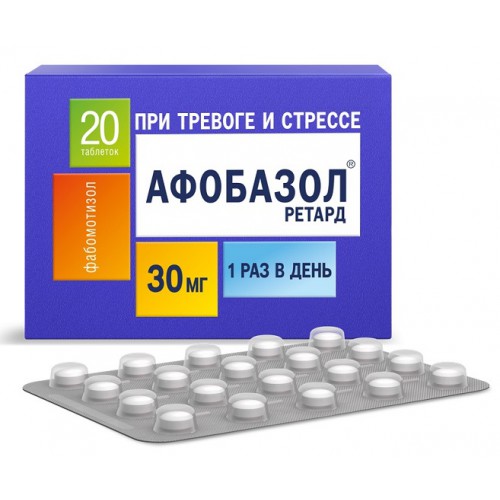
Extended-release film-coated tablets, 30 mg - 30 pcs with instructions for use in a pack.
Side effects
Adverse effects that may develop during treatment with AFOBAZOL® RETARD are classified according to the following frequency of occurrence:
very common (? 1/10), common (? 1/100 to < 1/10), uncommon (? 1/1,000 to < 1/100), rare (? 1/10,000 to < 1/1,000), very rare (< 1/10,000), frequency unknown (cannot be estimated from the available data).
From the immune system: frequency unknown - allergic reactions.
From the nervous system: rarely - headache, which usually goes away on its own and does not require discontinuation of the drug.
If you experience any of the side effects listed in the instructions or if they worsen, or if you notice any other side effects not listed in the instructions, tell your doctor.
Pharmacotherapeutic group
psycholeptics; anxiolytics; other anxiolytics
Interaction with other drugs
Fabomotizole does not interact with ethanol and does not affect the hypnotic effect of thiopental. It enhances the anticonvulsant effect of carbamazepine. It also enhances the anxiolytic effect of diazepam.
If you are using the above-mentioned or other medications (including over-the-counter ones), consult your doctor before using AFOBAZOL® RETARD.
Pharmacodynamics
Fabomotizole is a selective nonbenzodiazepine anxiolytic.
By acting on sigma-1 receptors in brain nerve cells, fabomotizole stabilizes GABA/benzodiazepine receptors and restores their sensitivity to endogenous inhibitory neurotransmitters. Fabomotizole also increases the bioenergetic potential of neurons and exerts a neuroprotective effect, restoring and protecting nerve cells.
The drug's action is realized primarily through a combination of anxiolytic (anti-anxiety) and mild stimulating (activating) effects. Fabomotizole reduces or eliminates feelings of anxiety (concern, bad feelings, apprehension), irritability, tension (fearfulness, tearfulness, restlessness, inability to relax, insomnia, fear), depressive mood, somatic manifestations of anxiety (muscular, sensory, cardiovascular, respiratory, gastrointestinal symptoms), vegetative disorders (dry mouth, sweating, dizziness), cognitive impairment (difficulty concentrating, impaired memory), including those arising in stress-related disorders (adjustment disorders). The drug is especially indicated for use in individuals with predominantly asthenic personality traits in the form of anxious suspiciousness, insecurity, increased vulnerability and emotional lability, a tendency to emotional and stressful reactions.
Fabomotizole does not cause muscle weakness or drowsiness and has no negative impact on concentration or memory. It does not cause addiction, drug dependence, or withdrawal symptoms.
Storage temperature
from 2℃ to 25℃
Dosage form
Round, biconvex, film-coated tablets of an off-white color. When viewed cross-sectionally, the core is off-white or white with a yellowish-brown tint.
Pharmacokinetics
After oral administration, fabomotizole is rapidly and well absorbed from the gastrointestinal tract. Food does not affect drug absorption or pharmacokinetic parameters.
The maximum concentration of fabomotizole in plasma (Cmax) after a single dose of AFOBAZOL® RETARD is 47.740±43.252 ng/ml, after multiple doses - 27.668±13.770 ng/ml; the time to reach the maximum concentration (Tmax) is 2.1±1.1 and 2.6±1.0 hours after a single and multiple doses, respectively.
Metabolism: Fabomotizole undergoes a first-pass metabolism in the liver, the main routes of metabolism being hydroxylation at the aromatic ring of the benzimidazole ring and oxidation at the morpholine moiety.
Fabomotizole is extensively distributed throughout well-vascularized organs and is characterized by rapid transfer from the central pool (blood plasma) to the peripheral pool (highly vascularized organs and tissues).
The half-life of fabomotizole after oral administration is 8.41±5.01 hours after a single dose and 6.05±3.54 hours after multiple doses of AFOBAZOL® RETARD. Fabomotizole is excreted primarily as metabolites and partially unchanged via the kidneys and feces.
Overdose
Symptoms
In case of significant overdose and intoxication, a sedative effect and increased drowsiness without manifestations of muscle relaxation may develop.
Treatment
As an emergency aid, 20% caffeine solution is used in ampoules of 1.0 ml 2-3 times a day subcutaneously.
If symptoms of overdose occur, stop taking the drug and consult a doctor immediately