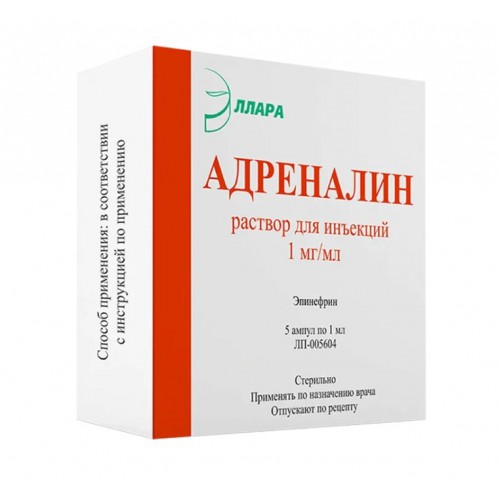
Expiration date: 09/2028
Dosage form
A transparent, colourless or slightly coloured liquid with a characteristic odour.
Compound
1 ml of solution contains:
Active ingredient:
epinephrine (adrenaline) - 1.00 mg.
Excipients:
sodium chloride - 8.00 mg, sodium disulfite (sodium metabisulfite) - 1.00 mg, chlorobutanol hemihydrate (chlorobutanol hydrate), equivalent to 5.00 mg chlorobutanol, disodium edetate - 0.50 mg, glycerol (glycerin)
- 60.00 mg, hydrochloric acid (hydrochloric acid) - up to pH 2.5 - 4.0, water for injection - up to 1 ml.
Pharmacotherapeutic group
alpha- and beta-adrenergic agonist
Pharmacodynamics
The action is due to the activation of receptor-dependent adenylate cyclase on the inner surface of the cell membrane, an increase in the intracellular concentration of cyclic adenosine monophosphate (cAMP) and calcium ions (Ca2+).
At very low doses, at an administration rate of less than 0.01 mcg/kg/min, it may reduce blood pressure due to skeletal muscle vasodilation. At an administration rate of 0.04-0.1 mcg/kg/min, it increases heart rate and force of contractions, stroke volume, and cardiac output, and reduces total peripheral vascular resistance. At doses above 0.02 mcg/kg/min, it constricts blood vessels, increases blood pressure (primarily systolic) and total peripheral vascular resistance. The pressor effect may cause a short-term reflex slowing of the heart rate.
Relaxes bronchial smooth muscles. Doses above 0.3 mcg/kg/min reduce renal blood flow, blood supply to internal organs, and gastrointestinal tone and motility. It dilates pupils, reducing aqueous humor production and intraocular pressure. It causes hyperglycemia (increases glycogenolysis and gluconeogenesis) and increases plasma free fatty acid levels.
Increases myocardial conductivity, excitability, and automatism. Increases myocardial oxygen demand. Inhibits antigen-induced histamine and leukotriene release, relieves bronchial spasms, and prevents mucosal edema.
By acting on ?-adrenergic receptors located in the skin, mucous membranes and internal organs, it causes vasoconstriction, a decrease in the rate of absorption of local anesthetics, increases the duration and reduces the toxic effects of local anesthesia.
Stimulation of b2-adrenergic receptors is accompanied by increased release of potassium ions (K+) from the cell and can lead to hypokalemia.
When administered intracavernously, it reduces the blood filling of the cavernous bodies.
The therapeutic effect develops almost instantly with intravenous administration (duration of action is 1-2 minutes), 5-10 minutes after subcutaneous administration (maximum effect is after 20 minutes), with intramuscular administration - the onset time of the effect is variable.
Pharmacokinetics
Suction
It is well absorbed when administered intramuscularly or subcutaneously. When administered parenterally, it is rapidly destroyed. It is also absorbed when administered endotracheally and conjunctivally. The time to reach maximum blood concentration after subcutaneous and intramuscular administration is 3-10 minutes. It crosses the placenta and is excreted into breast milk, but does not cross the blood-brain barrier.
Metabolism
It is metabolized primarily by monoamine oxidase and catechol-O-methyltransferase in sympathetic nerve endings and other tissues, as well as in the liver, to form inactive metabolites. The half-life after intravenous administration is 1-2 minutes.
Withdrawal
It is excreted by the kidneys mainly in the form of metabolites: vanillylmandelic acid, sulfates, glucuronides, and also in small quantities in unchanged form.
Indications
Immediate-type allergic reactions (including urticaria, angioedema, anaphylactic shock) that develop when using drugs, serums, blood transfusions, eating foods, insect bites or introducing other allergens; exercise-induced asthma;
- Bronchial asthma (relief of asthmatic status), bronchospasm during anesthesia;
- Asystole (including against the background of acutely developed third-degree atrioventricular block);
- Bleeding from superficial vessels of the skin and mucous membranes (including the gums);
- Arterial hypotension that is refractory to adequate volumes of replacement fluids (including shock, bacteremia, open heart surgery, renal failure);
- The need to prolong the action of local anesthetics;
- Episodes of complete atrioventricular block (with the development of syncope (Morgagni-Adams-Stokes syndrome));
- Stopping bleeding (as a vasoconstrictor).
Contraindications
Hypersensitivity to any component of the drug, arterial hypertension, severe atherosclerosis (including cerebral atherosclerosis), hypertrophic obstructive cardiomyopathy, tachyarrhythmia, ischemic heart disease, ventricular fibrillation, atrial fibrillation, ventricular arrhythmias, chronic heart failure grade 3-4, myocardial infarction, pheochromocytoma, thyrotoxicosis, diabetes mellitus, acute and chronic arterial insufficiency (including a history of arterial embolism, atherosclerosis, Buerger's disease, diabetic endarteritis, Raynaud's disease), hypovolemia, metabolic acidosis, hypercapnia, hypoxia, pulmonary hypertension, non-allergic shock (including cardiogenic, traumatic, hemorrhagic), cold injury, disease Parkinson's disease; organic brain damage, closed-angle glaucoma, seizure disorder, prostatic hyperplasia, age under 18 years (except for conditions that are immediately life-threatening), pregnancy, lactation, simultaneous use of inhalation agents for general anesthesia (halothane), epinephrine in combination with local anesthetics is not used for local anesthesia of the fingers and toes due to the risk of ischemic tissue damage.
In emergency situations, all contraindications are relative.
With caution:
Hyperthyroidism, old age.
To prevent arrhythmias during drug use, beta-blockers are prescribed.
Pregnancy and lactation:
see section "Contraindications".
Method of administration and dosage
Subcutaneously, intramuscularly, intravenously by drip.
Immediate-type allergic reactions (anaphylactic shock): 0.1-0.25 mg diluted in 10 ml of 0.9% sodium chloride solution, slowly intravenously; if necessary, continue intravenous drip administration at a concentration of 1:10,000. In the absence of an immediate threat to life, intramuscular or subcutaneous administration of 0.3-0.5 mg is preferable; if necessary, repeat administration after 10-20 minutes up to 3 times.
Bronchial asthma: subcutaneously 0.3-0.5 mg, if necessary, repeated doses can be administered every 20 minutes up to 3 times, or intravenously 0.1-0.25 mg with a dilution of 1:10000.
For asystole: 0.5 mg intracardially (diluted in 10 ml of 0.9% sodium chloride solution or another solution); during resuscitation measures - 0.5-1 mg (diluted) intravenously every 3-5 minutes. If the patient is intubated, endotracheal instillation is possible - the doses should be 2-2.5 times higher than the dose for intravenous administration.
Stopping bleeding - locally in the form of tampons soaked in a solution of the drug.
For arterial hypotension: intravenously by drip 1 mcg/min, the rate of administration can be increased to 2-10 mcg/min.
To prolong the effect of local anesthetics: at a concentration of 0.005 mg/ml (the dose depends on the type of anesthetic used), for spinal anesthesia - 0.2-0.4 mg.
Morgagni-Adams-Stokes syndrome (bradycardiac form) at a dose of 1 mg in 250 ml of 5% glucose solution intravenously, gradually increasing the infusion rate until the minimum sufficient number of heart contractions is achieved.
As a vasoconstrictor: intravenously by drip 1 mcg/min; the rate of administration can be increased to 2-10 mcg/min:
Application in pediatric practice:
Newborns (asystole): intravenously, 10-30 mcg/kg every 3-5 min, slowly.
For children: over 1 month: intravenously, 10 mcg/kg (subsequently, if necessary, 100 mcg/kg is administered every 3-5 minutes (after administration of at least 2 standard doses, higher doses of 200 mcg/kg can be used every 5 minutes). Endotracheal administration can be used.
For children with anaphylactic shock: subcutaneously or intramuscularly at 0.01 mg/kg (maximum - up to 0.3 mg), if necessary, the administration of these doses is repeated every 15 minutes (up to 3 times).
For children with bronchospasm: subcutaneously 10 mcg/kg (maximum - up to 0.3 mg), doses are repeated if necessary every 15 minutes; (up to 3-4 times) or every 4 hours.
Side effects
Classification of the frequency of development of side effects (WHO):
very common >1/10;
often from > 1/100 to < 1/10
uncommon from > 1/1000 to < 1/100
rare from >1/10000 to < 1/1000,
very rare from < 1/10000, including isolated reports.
From the cardiovascular system: uncommon - angina pectoris, bradycardia or tachycardia, palpitations, increase or decrease in blood pressure, at high doses - ventricular arrhythmias (including ventricular fibrillation); rare - arrhythmia, chest pain, pulmonary edema.
From the nervous system: often - headache, anxiety, tremor; tic, uncommon - dizziness, nervousness, fatigue, nausea, vomiting, personality disorders (psychomotor agitation, disorientation, memory impairment, psychotic disorders: aggressive or panic behavior, schizophrenia-like disorders, paranoia), sleep disturbance, muscle twitching.
From the digestive system: often - nausea, vomiting.
From the urinary system: rarely - difficult and painful urination (with prostatic hyperplasia).
Local reactions: uncommon - pain or burning at the site of intramuscular injection.
Allergic reactions: uncommon - angioedema, bronchospasm, skin rash, erythema multiforme.
Others: uncommon - increased sweating; rare - hypokalemia.
If the side effects listed in the instructions worsen, or you notice any other side effects not listed in the instructions, tell your doctor.
Overdose
Symptoms: excessive increase in blood pressure, tachycardia alternating with bradycardia, rhythm disturbances (including atrial and ventricular fibrillation), cold and pale skin, vomiting, headache, metabolic acidosis, myocardial infarction, cranial hemorrhage (especially in elderly patients), pulmonary edema, death.
Treatment: stop administration, symptomatic therapy - to reduce blood pressure - ?-blockers (phentolamine), for arrhythmia - ?-blockers (propranolol).
Drug interactions
Epinephrine antagonists are ?- and b-adrenergic receptor blockers.
The effectiveness of epinephrine is reduced in patients with severe anaphylactic reactions taking beta-blockers. In this case, intravenous salbutamol is used.
Use in combination with other adrenergic agents may enhance the effect of epinephrine.
Weakens the effects of narcotic analgesics and hypnotics.
When used simultaneously with cardiac glycosides, quinidine, tricyclic antidepressants, dopamine, inhalation anesthetics (enflurane, halothane, isoflurane, methoxyflurane), cocaine, the risk of developing arrhythmias increases (use together with extreme caution or not at all); with other adrenergic agonists - increased severity of side effects from the cardiovascular system; with antihypertensive drugs - decreased their effectiveness.
With diuretics - possible increase of the pressor effect of epinephrine. Concomitant use with drugs that inhibit monoamine oxidase (procarbazine, selegiline, and furazolidone) may cause a sudden and pronounced increase in blood pressure, hyperpyretic crisis, headache, cardiac arrhythmia, vomiting; with nitrates - weakening of their therapeutic effect; with phenoxybenzamine - increased hypotensive effect and tachycardia; with phenytoin - a sudden decrease in blood pressure and bradycardia (depending on the dose and rate of administration); with hormonal drugs, thyroid gland - mutual enhancement of action; with drugs that prolong the QT interval (including astemizole, cisapride, terfenadine) - prolongation of the QT interval; with diatrizoates, iothalamic or ioxaglic acids - increased neurological effects; with ergot alkaloids - increased vasoconstrictor effect (up to severe ischemia and development of gangrene).
Reduces the effect of insulin and other hypoglycemic drugs.
Special instructions
Accidental intravenous injection of epinephrine can cause a sharp increase in blood pressure.
Increased blood pressure during drug administration may trigger angina attacks. Epinephrine may cause renal capillary constriction, thereby reducing diuresis.
When administering infusion, a device with a measuring device should be used to regulate the infusion rate.
Infusions should be administered into a large (preferably central) vein.
It is administered intracardiacally during asystole if other methods are not available, as there is a risk of cardiac tamponade and pneumothorax.
During treatment, it is recommended to determine serum potassium (K+) levels, blood pressure, urine output, cardiac output, electrocardiogram, central venous pressure, pulmonary artery pressure, and pulmonary capillary wedge pressure. Excessive doses during myocardial infarction may exacerbate ischemia by increasing myocardial oxygen demand.
Increases glycemia, which is why diabetes mellitus requires higher doses of insulin and sulfonylurea derivatives.
When administered endotracheally, absorption and final plasma drug concentrations may be unpredictable.
The administration of epinephrine in shock conditions does not replace the transfusion of blood, plasma, blood substitutes and/or saline solutions.
Epinephrine should not be used for a long time (narrowing of peripheral vessels, leading to the possible development of necrosis or gangrene).
There are no strictly controlled studies of epinephrine use in pregnant women. A statistically significant association has been established between the occurrence of malformations and inguinal hernias in children whose mothers used epinephrine during the first trimester or throughout pregnancy. One case of fetal anoxia has also been reported following intravenous administration of epinephrine to the mother.
Use to correct low blood pressure during labor is not recommended, as it may delay the second stage of labor; when administered in large doses to weaken uterine contractions, it may cause prolonged uterine atony with bleeding.
Can be used in children with cardiac arrest, but caution should be exercised.
When stopping treatment, the dose should be reduced gradually, since sudden discontinuation of therapy may lead to a decrease in blood pressure.
It is easily destroyed by alkylating agents and oxidizing agents, including chlorides, bromides, nitrites, iron salts, and peroxides.
If the solution has become pinkish or brown in color or contains sediment, do not administer it. Discard any unused portion.
Impact on ability to drive and use machines:
After using the drug, the doctor must individually, in each specific case, decide on the patient’s admission to driving or engaging in other potentially dangerous activities that require increased concentration and quick psychomotor reactions.
Release form/dosage:
20, 50 or 100 blister packs with 20, 50 or 100 instructions for use of the drug, respectively, knives or ampoule scarifiers in cardboard boxes or corrugated cardboard boxes (for hospital use).
When packaging ampoules with notches, rings and break points, ampoule knives or scarifiers are not included.
Storage conditions:
In a place protected from light, at a temperature not exceeding 15 °C.
Keep out of reach of children.
Storage temperature
from 2℃ to 15℃